
In concrete construction and finishing, a flawless surface involves more than just aesthetics: it involves strength, durability, and long-term performance. This task has been made easier with the advent of the power trowel. This machine levels, densifies, and smooths concrete slabs with ease. Power trowels can help you determine the best finishing touches for warehouse floors, commercial slabs, or high-end residential garages. For your power trowel, finishing touches can be a game-changer in improving your construction services.
This guide contains an in-depth exploration of what a power trowel is, how it functions, the various trowel types, the appropriate timing and usage of trowels, power trowel specifications, the diverse trowel benefits, frequent power trowel mistakes, and their corresponding best practices. By the end, you will understand how to use power trowels for your construction-machine business or job site.
What is a Power Trowel?
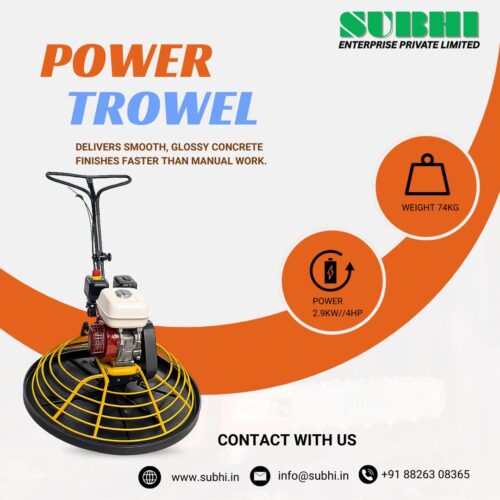
A Power Trowel is a piece of light construction equipment. (Sometimes referred to as a “power float” or “troweling machine”). Contractors and concrete finishers use power trowels to smooth concrete slabs. (Wikipedia) Briefly, after concrete has been placed, screeded, and has partly set, the power trowel is used to flatten, compact, and polish the surface.
The machine uses rotating blades (or optional float pans) that serve to cover the area of the float machine with a rotating attachment that skims along the surface of the pavement, just enough to “lip” (bring to the surface) the cement paste and push out the excess water trapped underneath. This will yield a denser and smoother finish. (canberradiamondblade.com.au)
When it comes to developing a consistent approach to finishing large slab surfaces quickly, the machine power trowel, with its mechanized version of much hand trowelling and floating, floating, and darby work, is the best option.
Why Use a Power Trowel?
These are the key drivers in the use of power trowels in finishing concrete:
Enhanced surface flatness and finish: The machine will ensure the blades are evenly distributed, eliminating high and low areas and attaining a uniform surface (blog.bartellglobal.com)
Reduced time and manpower: The power trowel serves to quickly finish a large area, greatly reducing the time concrete is left to set in a “green” state (catrentalstore.com)
Enhanced slab density and wear resistance: The machine trowel will push out water, air, and excess water trapped in the upper slab layer, compressing it, thus improving density and wear resistance (blog.bartellglobal.com)
Enhanced appearance and function: A smooth, level surface minimally hinders the cleaning process and greatly improves the look of the area.
You gain more precise control over timing and quality of the finish. With the right amount of experience, you can master control over the blade pitch, the RPM, and the number of passes, thereby customizing the finish (matte, smooth, hard, burnished) as needed. (Fine Homebuilding)
Therefore, if your business is finishing services, concrete slabs for buildings, or concrete flooring, the power trowel will be a key and strategic investment.
Power Trowel Types
Knowing the different types allows you to choose the right machine for the task at hand.
Walk-Behind Power Trowel
- These are operated by an operator walking behind the machine, guiding it via a handle. (catrentalstore.com)
- Ideal for medium to small slabs, around columns, edges, and tight spaces.
- Usually single rotor (one spinning assembly). Blade diameters are often from ~24″–48″, depending on the model. (catrentalstore.com)
- More affordable and portable; good for residential or smaller commercial jobs.
Ride-On Power Trowel
- These are larger machines where the operator sits on the machine and controls it via steering levers. (Wikipedia)
- Designed for large open slab areas (warehouses, industrial floors) where speed and coverage matter.
- Typically, dual-rotor assemblies with larger blades or pans.
- Higher cost and heavier equipment, but vastly more productive per hour.
Other Variations & Features
Float pans vs finishing blades: Some machines employ large metal pans early in the sequence to “float” the slab (distribute weight, avoid digging in) and later switch to finishing blades for burnishing and polishing. (blog.bartellglobal.com)
Electric vs petrol/diesel: Depending on job site conditions (indoor, ventilation, emissions), you may choose electric machines. (becosan.com)
Blade pitch adjustability, throttle/RPM control, tilt mechanisms: These features allow finer control of finish quality.
Choosing the Right Power Trowel for Your Projects
When deciding what power trowels should be for sale, rented, or used for your company (as Subhi Enterprises), several considerations should be made that include the following:
Area Size & Project Scope
The bigger the space, the bigger and quicker the machine needed. A 24–36″ walk-behind trowel is adequate for smaller slabs, but for bigger slabs, trowels that are 46″, 60″, or larger ride-on trowels are appropriate. (Tomahawk Power)
Blade Diameter / Working Width
Choosing the appropriate diameter is critical to coverage and efficiency. The larger the diameter, the more surface area is cleared per pass, reducing the number of passes needed, and consequently the time and labour. (Tomahawk Power)
Job Site Access & Obstacles
If your slab has several columns, walls, or barriers such as door openings, or is limited in space within the building, a walk-behind model may be the best. A ride-on is ideal for open warehouse floors. (catrentalstore.com)
Concrete Mix & Finish Goal
For tightly controlled, high RPMs, superior blades, and more powerful machines are needed for fast-setting concrete or high gloss finishes, especially when the concrete needs to be polished. The pitch of the blades, the range of RPMs, and the quality of the blades are crucial. (blog.bartellglobal.com)
Return on Investment
Budget, cost of the machine, maintenance, operator training, frequency of the job, purchasing versus rental cost, and renting or purchasing are all factors to consider. The right machine is a worthwhile investment for companies doing many slabs.
Operator Skill & Safety
Even the best equipment needs operators with experience. For less experienced crews, it may be beneficial to select a simpler machine. Review the machine’s safety features, ergonomics, and ease of transport as well. (blog.bartellglobal.com)
How a Power Trowel Works
Basics of Operation
Understanding the machine operation will allow you to train operators and save you from costly mistakes.
Initial Preparation
After pouring and screeding the concrete, you perform the floating (with hand tools or the machine with float pans) to level and prepare the surface to be finished troweled.
When to Start the Trowel
Timing is key. The slab must have set enough so that you can walk on it without leaving a deep imprint, but not so long that finishing the surface will be hard to do. (Fine Homebuilding)
If you go too early, the trowel will gouge the surface. If you wait too long, you will find it hard to finish the slab, and blisters may form.
Machine Setup
Attach the right blades or float pan.
Adjust the pitch of the blades: begin with a flat (0 to slight pitch) position on the early passes. As the slab hardens, you will increase the pitch to burnish. (blog.bartellglobal.com)
Adjust the machine to the correct engine speed/RPM and check that it is level and safe.
Operation Passes
First pass: walk-behind or ride-on, use low pitch, and distribute weight evenly. In subsequent passes, it is recommended that the operator change the direction of travel approximately 90 degrees from the previously completed pass. The passes should be overlapped to ensure that there are no lines or ridges left unworked along the surface (catrentalstore.com).
When completing the final passes, set the blades to finish, and use a higher pitch along with lower RPM (in some cases) to achieve the burnished finish.
Edge & Detail Work
The use of power trowels will not allow complete coverage of all edges, corners, and any obstacles. This will necessitate the use of hand finishing along with smaller machines to tie edges. Often, a combination of machine and hand is the preferred approach to complete the job.
Safety & Control
Lingering in one spot will result in the machine digging in or over-burning, so do not do this (Fine Homebuilding).
The operator should maintain control of the machine’s handle. For the walk-behind trowels, the operator controls direction through vertical handle movements, while horizontal movements steer the machine to the left or right (blog.bartellglobal.com).
PPE should include hearing, eye, and foot protection for the operator. Trip hazards should be removed (becosan.com).
Benefits Specific to Your Construction-Machinery Business
With your current business model (business-to-customer, dealing in construction machinery), focusing on the power trowel makes the most sense for the following reason:
Increase the range of products you offer. If you currently deal in concrete mixers, rebar machines, etc., the addition of power trowels gives you a finishing-equipment angle and broadens your market. You can direct your marketing to contractors and builders. Many contractors will be interested in complete floor-finishing workflows – from pouring to finishing. This offers the opportunity to bundle or cross-sell.
Rental or resell opportunities: There is a high demand for finishing machinery, which means you can supply, purchase, or rent machines, and even set up service contracts.
Value proposition: Point out how your power trowels can cut finishing time, save on labour expenses, and enhance the durability of slabs. This will help sellers and contractors defend their purchase.
After-sales services: You can offer maintenance, blade changes, and training on operation. This positions you as a problem solver instead of just a machine supplier.
Power Trowel Machine Specifications Table
| Parameter | Description / Specification |
|---|---|
| Blade Diameter (Rotor Diameter) | 900 mm – 1200 mm (varies by model) |
| Power per Engine/Motor | 5.5 HP – 13 HP (4.1 kW – 9.7 kW) |
| Drive Type | Mechanical / Hydrostatic (depending on model) |
| RPM Range | 60 – 150 RPM |
| Blade or Pan Quantity | 4 or 5 blades (based on model) |
| Machine Weight | 90 – 250 kg |
| Blade Pitch Adjustment Mechanism | Manual / Quick Adjust Lever |
| Controls (Ride-On Models) | Dual joystick steering, seat with safety lock |
| Ergonomics | Adjustable handles, vibration-dampening design |
| Maintenance Access | Easy access panels for engine, gearbox, and belt maintenance |
| Transport Dimensions | Approx. 1200 mm × 1000 mm × 800 mm |
| Manufacturer Reputation & Spare Parts Availability | Subhi Enterprises – Reliable supply and service support across India |
| Safety Features | Protective blade guard, emergency stop switch, low vibration & noise levels |
Conclusion
Choosing, using, and maintaining a power trowel affects the quality of the concrete finish, which determines the durability of the slab. For your business, Subhi Enterprises, acquiring power trowels signifies that you can now offer finishing equipment for sale and rent. It also opens opportunities for integrated service offerings.
Still, the effectiveness of any machine depends on the operator and the sequence of activities. Observe time, blade, directional pass, control, and upkeep of the machine. With good power trowels, proper planning often streamlines construction activities.
For India, if you want, I can provide specific cost comparisons, SEO integrations as meta description, headers, suggested alt texts, and more-along with images related to blogs for your website.