
Screed Vibrators-Engines are some of the important pieces of construction machinery that modern construction relies on to give even, smooth, and durable surfaces of concrete. Be it floor construction, slabs of industrial buildings, pavement, or even parking lots, this heavy-duty machine compacts the concrete consistently and without any air pockets. In the article below, we will discuss working principles, different types, applications, tips on its maintenance, and reasons why it is indispensable in every construction project.
What are screed vibrators (engine)?
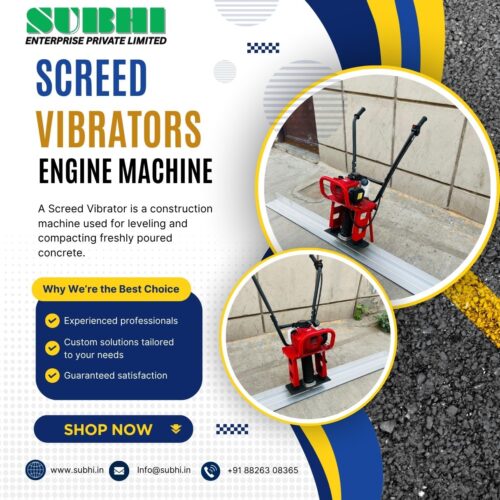
A Screed Vibrator-Engine, or just an engine, is a construction machine used in laying and compacting concrete just after being poured into place. By vibration, it removes air bubbles, allowing the concrete to be dense and smooth. This machine essentially consists of a long screed blade driven by an engine that creates vibration to enable the concrete to settle down.
Screed Vibrators-Engine While manual screeding requires more labor and time, Screed Vibrators-Engine offer speed, accuracy, and consistency in their results. They are very frequently used for big concrete pouring, where the quality and uniformity of the surface are of primary importance.
How Do Screed Vibrators (Engine) Work?
In principle, the working mechanism involved in a screed vibrator is quite simple and effective. The engine is usually petrol or diesel-driven and is connected to an eccentric shaft that generates the vibration. These vibrations are transmitted along the screed blade to the wet surface of the concrete. Due to this process, the particles of concrete settle down, excess air is expelled, and then the surface is levelled and dense.
The operator guides the screed across the concrete surface while the engine applies consistent vibration. This produces a properly thick, level, and smooth top layer of concrete.
Screed Vibrators (Engine) - Types
In the area of construction, there are different Screed Vibrators-Engine available. Each suits a type of need for the various projects as far as surface area, concrete thickness, and mobility requirements.
- Single Beam Screed Vibrator: Most common type used for small slabs and flooring projects; lightweight and easy to handle, especially when leveling over short distances.
- Double Beam Screed Vibrator: Equipped with two vibrating beams for better compaction of the surface, this model has been designed for large concrete surfaces, featuring more stability and covering a larger area per pass.
- Truss Screed Vibrator: The truss screed is used for industrial or road construction, and it is very efficient and bridges a wide span. It is suitable for large projects such as runways, bridges, and factory floors.
- Walk-Behind Screed Vibrator: This type enables the operator to walk behind the machine in the process of leveling the surface. This is convenient for medium-scale construction works.
Each model has its own benefits in the Screed Vibrators-Engine series, and their selection depends on the project size, required finish quality, and site conditions.
Engine Options in Screed Vibrators
The Screed Vibrator Engine is the heart of any screed vibrator; it determines the strength of vibration, fuel efficiency, and performance, among other factors. Presently, some of the most prevalent types are:
Petrol Engine: These are normally used outdoors as they are portable and reliable.
Diesel Engine: It is for heavy work, big power, and long running time.
Electric Option: This is suitable for indoor and low-noise zones, though not categorized under “engine type.”
The petrol and diesel-powered Screed Vibrators are usable in remote sites or large-scale sites where electric connections are unavailable.
Key Components of Screed Vibrators (Engine)
To understand how efficiently a Screed Vibrators-Engine performs, it’s important to know its main parts.
Engine Unit: It supplies power to the vibrators.
Vibrating Shaft: It transfers rotational energy to vibration.
Screed Blade: Distributes the vibration and levels the surface.
Handle: The portion of the machine that an operator uses to control or direct it.
Frame: It provides stability and support to the engine.
All of these components need to be checked and maintained on a regular basis for ultimate performance and long life.
Applications of Screed Vibrators (Engine)
Screed Vibrators-Engine find their most common uses across a wide number of areas:
from residential to industrial sites.
Applications include the following: construction of building floors to ensure smooth and level surfaces in homes, offices, and commercial areas; parking lots for substantial, level concrete to take the weight of vehicles.
Industrial Slabs: These are strong bottoms that don’t vibrate, making them great for warehouses and factories. Pavements and driveways help you make smooth, level concrete surfaces.
Road Construction: It aids in laying even, compact layers of concrete for highways and bridges.
Screed vibrators come into play wherever a question of concrete finishing is at hand.
Benefits of Using Screed Vibrators (Engine)
The application of Screed Vibrators-Engine presents several advantages over manual screeding. Some of the key advantages are as follows:
1. Enhanced Surface Quality
Consequently, the vibration distributes the concrete evenly and removes air pockets, hence making it smooth.
2. More efficient
It cuts down on the amount of time and money needed to finish a project by covering more ground in less time.
3. Better Compaction
Makes concrete denser, stronger, and more durable.
4. Makes things easier for people
It doesn’t need as many people as other classic screeding procedures.
5. Consistent Results
Each section of concrete is compacted and leveled uniformly.
6. Versatility
Screed vibrators can be applied to a wide variety of concrete works-from the tiniest slab to large industrial floors.
How to Safely Operate Screed Vibrators (Engine)
Although operating an engine vibrator or screed is, in principle, quite straightforward, safety is always the first concern. The principal practices for safety are:
- Check the fuel level: The engine should have appropriate levels of fuel before use.
- Check for loose equipment parts, damaged wires, or worn-out blades before use.
- Wear protective gear to include gloves, goggles, and protection for your ears.
Start slow: start with low vibration settings and work your way up in time.
Keep proper posture: hold handles firmly and guide smoothly. Avoid over-vibration, as it might affect the surface of the concrete.
By following these, both operator safety and quality output are guaranteed.
Maintenance Tips for Screed Vibrators (Engine)
Proper maintenance not only extends the machine’s life but also keeps its performance consistent.
Routine maintenance activities include: Daily Cleaning, removing concrete residue after each use.
Engine Check: Periodic checks on oil, filters, and fuel lines.
Blade Care: The Screed blade should be cleaned and kept straight.
Bolt tightening: All nuts and bolts should be well tightened.
It requires less manual labor as compared to other traditional screeding methods.
Store in a dry place free of dust to avoid corrosion.
Long-term reliability depends upon scheduled servicing according to the manufacturer’s recommendations.
Selection of Correct Screed Vibrators (Engine)
The following should be considered in the choice of the right screed vibrator-engine for your job:
Surface Area: A double-beam or truss screed is essential for larger jobs.
Power Source: Decide on either a petrol or diesel version, depending on access on site.
Blade Length: Choose blade size based on concrete slab width.
Vibration Frequency: Varies depending on concrete density.
Portability: Lighter models are more suitable for smaller tasks.
These parameters will make sure that you get a machine matching the requirements of the job while meeting the budgetary needs of the project.
Common Mistakes to Avoid
Even the best Screed Vibrators (Engine) cannot save your results from mistakes. Steer clear of the following common errors:
- Over-vibration of the Surface causes segregation of concrete.
- Using a Dirty Blade leads to an uneven finish.
- The wrong Frequency of Vibration leads to reduced compaction efficiency. Neglecting maintenance leads to early wear and breakdowns.
- Maximum machine life and quality of concrete can be obtained by avoiding such mistakes.
Future of Screed Vibrators (Engine) As the technology of construction is continuously updated, Screed Vibrators-Engine have also been renewed.
Newer versions have been attributed with the following traits:
- Fuel-efficient performance engines with reduced emissions.
- Lightweight and easily handled materials.
- Vibration controls allow adjustment for precision work.
- Low-noise operation suitable for urban sites.
Equipped with these innovations, Screed Vibrators (Engine) are more reliable, ecologically clean, and comfortable for the user than ever.
Conclusion
Perfect concrete finishing is not a question of skill in today’s construction industry but one of proper equipment. For speed, precision, and quality, the screed vibrator is indispensable to the serious contractor or builder-from small areas of residential floors to giant industrial projects, they turn out the job unvaryingly smooth and strong. A high-quality Screed Vibrator (Engine) is worth every cent invested, for it boosts your productivity and strengthens the durability of your structures. Whether you are a builder, contractor, or civil engineer, understanding how these machines work and their maintenance will ensure your success in every concrete project.