
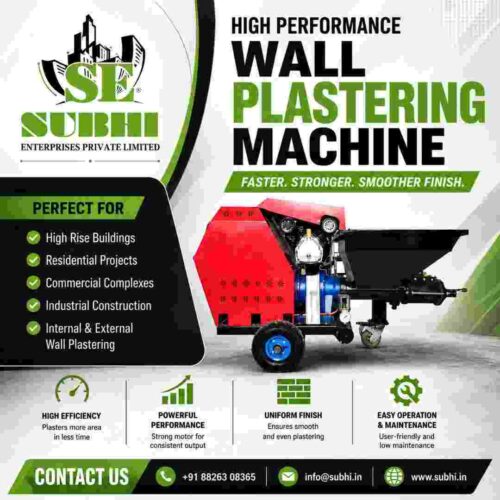
Time, quality, and efficiency play an essential role in the current construction business. The conventional way of plastering is very laborious, and therefore it ends up increasing the total cost of the project as well as lowering its quality. In order to counteract this, there is a lot of adoption of modern construction machinery, including the wall plastering machines.
Machines are plastering machines that automatically apply mortar on the walls. The machines are designed for leveling of the mortar applied to walls. The machines can be very effective in various building projects such as residential, commercial, multipurpose, industrial, and warehouse ones.
A machine is an advanced construction machine that aids in the application of plaster or mortar to walls and ceilings. This wall plastering machine hoses and pumps a premixed mortar and sprays it onto the surface of a wall, replacing the manual application of plaster and making a unit wall of even thickness.
These machines are equipped with a substantial and powerful pumping system, a motor, a control panel, and a spray gun. All of these wall plastering machine components, when integrated, give the operator the ability to plaster quickly and continuously. This also allows the operator the ability to complete the plastering of a wall to a high level of quality in a fraction of the time compared to plastering by traditional methods.
Why Get a Wall Plastering Machine?
Advantages of purchasing a machine include saving time and money on plastering tasks without compromising on quality.
- Tasks Completed More Quickly
There is no match for how fast plastering machines help complete the process. In the case of conventional plastering techniques, plastering the whole wall may take a whole day, and the work becomes too laborious. Thanks to the plastering machine, contractors can plaster much larger areas of walls, hence completing the task quickly.
- Uniform Surface
An inconsistent and poor finished surface is characteristic of manual plastering. With a machine, plaster is evenly and uniformly distributed, resulting in a professionally finished surface that is almost free of any imperfections.
- Fewer workers
Skilled laborers for plastering are often difficult to come by and expensive. Because machines do most of the plastering work, reliance on labor is less, and costs are less. This also results in an increase in the overall plastering process.
- Efficiency
Machines work by pumping and spraying plaster continuously. This creates an uninterrupted workflow that results in a faster job being done without sacrificing the quality.
- Saving Money on Materials
With a machine, plaster is distributed in the correct and even amount, eliminating significant waste. Because of this, the costs of materials is significantly reduced over time.
How Does a Wall Plastering Machine Work?
Using a machine is a very straightforward process. The plastering mixture is prepared to specifications. After this, the mixture is placed in the machine via the hopper.
The machine has a pump system that sends the mortar through a hose to the spray nozzle. The operator uses a spray gun to apply the mortar to the wall. Once all the plaster has been sprayed, tools can be used to finish the wall and make it smooth.
This system speeds up the process to plaster large areas of wall and make it look consistent.
Components of a Wall Plastering Machine
- High-Performance Pumping System
A powerful pump makes sure that the machine can continuously spray mortar and can be used for longer periods of time on a job site.
- Durable Construction
The materials used to make the machine ensure that it lasts and can be used in tough conditions.
- Easy Operation
Modern plastering machines are easy to control due to their simplicity, making it possible for any worker to work with the machine regardless of their lack of experience.
- Adjustable Output
The user is allowed to adjust the output according to the plastering task.
- Mobility
Most wall plastering machines come equipped with wheels for mobility.
- Low Maintenance
The machine is reliable and if it is used and cleaned properly, it does not require much maintenance
Uses of a Wall Plastering Machine
A machine can be used in many construction jobs, such as
- Residential Buildings
Plastering machines are used by builders to quickly smooth the wall finishes in homes.
- Commercial Projects
Plastering within offices, shopping malls, hotels, and other commercial complexes is faster and improves productivity.
- Industrial Buildings
Factories and warehouses have large solid wall surfaces. machine plastering makes these constructions faster.
- Educational Institutions
Modern machine plastering can reduce the time to build schools, colleges, and universities.
- Healthcare Facilities
Hospitals and healthcare centers need wall finishes of high quality. A machine offers consistent quality and professional finishes.
Benefits for Contractors and Builders
Machines offer multiple advantages to a business for an industry that is always seeking new ways to boost efficiency and profitability.
- More Productive Workforce
Workers can plaster significantly larger areas in a day as opposed to the previous way. This allows contractors to complete considerably more work in a year.
- Improved Quality Control
Plastering to a consistent thickness is an improved quality of a finish and builds greater satisfaction for the client.
- Edge Over Competition
To stay in the game of construction, contractors must be able to complete a job in the least amount of time. Using the best, most modern equipment offers an edge over the competition.
- Save Money Over Time
The outlay of capital for the purchase of a machine will be recouped with savings from reduced labor costs, less material waste, and no more delays in the completion of a job.
- Safety Benefits
The activeness of work and plastering requires a lot of physical and repetitive movement. This causes fatigue. A wall plastering machine greatly minimizes fatigue and improves worksite safety.
By keeping a distance from the walls and elevated areas that are plastered, safety is further enhanced.
Choosing a Wall Plastering Machine
There are many factors to consider when buying a machine. Among these are:
Size and scope of your typical projects
- Type of mortar
- Pumping power
- Ease of use
- Required maintenance
- Power costs
How readily available the spare parts are
- Support and service of the manufacturer
- The right choice of wall plastering machine will boost productivity and has the highest ROI.
- Plastering machines are an investment, so it is best to think about machine maintenance.
Maintenance Tips
To get the best performance and longevity out of your wall plastering machine, consider the following maintenance tips.
- Always thoroughly clean the machine after each use.
- Hoses and fittings should be inspected regularly.
- Moving parts should be lubricated when due.
- Connections should be checked regularly.
- Worn parts should be replaced.
The maintenance schedule of the machine should be followed.
There is an upfront cost to maintenance, but there are savings from decreased machine downtime.
The Future of Construction Plastering
Construction projects are getting larger and more difficult to manage, so wall plastering machines and construction automation are getting more sophisticated. Modern construction technology has helped plastering machines automate a traditionally labor-intensive trade. The plastering machine helps improve construction speed and quality and reduces construction costs. To stay competitive, construction companies are seeking out solutions to optimize construction productivity. Companies that adopt plastering machines now will have a competitive advantage over companies that don’t.
Conclusion
The machine has greatly changed the plastering process in construction. Projects are faster and more cost-efficient, labor has been reduced, and the quality of the plastering has greatly improved. The Wall Plastering Machine is the best solution for residential, commercial, and industrial projects.
A machine is a great construction investment for construction contractors trying to get more work done while still getting excellent results. Because of the many benefits and great features wall plastering machines offer, they have officially become a necessity for modern construction.
FAQs
1. What is a Wall Plastering Machine?
Wall Plastering Machine take care of the tedious and time-consuming process of manually plastering ceilings and walls. By using machines, you are guaranteeing that the finish will be smooth and even, and you will have a lot more time to focus elsewhere, as these machines drastically increase overall productivity and decrease the labor needed for plastering walls.
2. How does a wall plastering machine work?
A wall plastering machine has a hose that pumps and sprays the mortar onto the wall. After the mortar is plastered onto the wall, it is then evenly smoothed and finished like it would be if done manually using other plastering tools.
3. What are the benefits of using a wall plastering machine?
Using a wall plastering machine has many benefits; some of these are getting plastering done a lot faster, having walls finished smoothly and evenly, and seeing a boost in productivity and plastering costs.
4. Is the wall plastering machine designed exclusively for large-scale construction?
No, a wall plastering machine can be used for any construction, whether it is a residence or an industrial building.
5. Which type of plasters can be used for wall plastering machines?
Some are listed below:
- Cement mortar
- Ready-mixed plaster
- Gypsum plaster
- Lightweight mixture of mortars
For getting optimum results, one should use any one of these as recommended by the manufacturers.
6. How much area can these machines cover in a day?
The capacity of each Wall Plastering Machine varies; however, depending on the machine model, state of walls and efficiency of operators, a wall plastering machine can cover 500 – 1500 sq ft in a day.
7. Does the machine require skilled operators?
One of the advantages of a wall plastering machine is the ease of operation. Operators only require a basic amount of training to be able to operate the machine.
8. Is a wall plastering machine suitable for high-rise buildings?
Yes, modern wall plastering machines can pump mortar vertically and can easily be used for multi-story and high-rise buildings.
9. How does the machine help to reduce construction costs?
The Wall Plastering Machine reduces dependence on labor, reduces material wastage, and increases the speed of work and subsequently reduces the finishing time of the project.
10. Is there a lot of maintenance required for a wall plastering machine?
No, as long as the wall plastering machine is cleaned regularly after use and the hoses and equipment are inspected and lubricated, the machine will continue to perform well.
11. Can the machine plaster ceilings as well as walls?
Indeed, modern wall plastering machines can perform wall and ceiling plastering tasks.
12. How long can a wall plastering machine serve?
A wall plastering machine can be used for years if the machine is of good quality and properly serviced.
13. Which is better—machine plastering or manual plastering?
Machine plastering is much better. The machines can help in making the mortar flow very smooth; thus, the thickness becomes uniform. Due to this, a far better finish can be obtained than that of the manual plastering process.
14. Which energy source is used by a wall plastering machine?
Based on the model type, the machine uses either the following or
- Single-phase electrical power
- Three-phase electrical power
- Diesel-powered system