
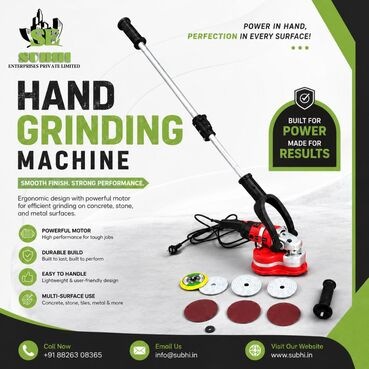
A Hand Grinding Machine can be used to grind, cut, polish, deburr or finish different kinds of materials. This compact way of having a tool that can do many things makes it a favorite for professionals in workshops and on construction sites. These compact machines make doing several lengthened tasks a lot easier and efficient.
A Hand Grinding Machine can make a big difference for contractors, welders, fabricators and mechanics. All of these professions spend a lot of time manually finishing work pieces. A good grinder in these situations makes it faster and easier to remove material and get consistent results, thus lessening how much the operator has to do.
We have outlined everything you could want to know about a Hand Grinding Machine. This includes the principle of how it works, different machine types, how to use a Hand Grinding Machine, the benefits of having one, and everything you want to know about the features, how to look after it, safety tips and how to buy a grinder.
What Is a Hand Grinding Machine?
A Hand Grinding Machine is one of the more flexible tools in the workshop. It is a portable grinder that can be pneumatic or electric. The machine has a motor, a spindle, a protective cover, a handle and a power switch. The disc is replaced with an abrasive wheel. The high speed of the spinning disc creates friction with the work surface and helps in removing extra material from the work surface. Different attachments used on a grinder allow for different functions, such as cutting, polishing and sanding.
Compared to larger stationary grinders, Hand Grinding Machines are a lot lighter in weight and portable. This makes them useful for work that is done off site.
How Do Hand Grinding Systems Work?
A hand grinding system has a simple design.
The system has a high-speed motor that rotates a spindle. An abrasive disc or wheel is mounted on a spindle. An operator controls the action of the disc by moving the disc along a surface. Different discs perform different functions like removing metal from a surface, finishing a surface and removing rust among others.
The following are the basic steps of the working process of a hand grinding system:
- Select disc for grinding or cutting.
- Mount disc on spindle.
- Check the machine and guard.
- Wear appropriate personal protective equipment.
- Power on machine until rotational speed is attained.
- Grip tool in both hands.
- Put controlled pressure on workpiece.
- Move machine along the surface.
- Power off machine.
- Wait until spindle stops. Place tool on rest.
Principles of disc selection and machine use determines completion of the task.
Different Types of Hand Grinding Systems
One of the main advantages of a hand grinding system is its adaptability for use in all types of construction, fabrication, maintenance, and other industrial activities.
- Grinding of Metals
A grinder can be used toouch away surplus metal from fabricated structures, joints and other metal components.
- Weld Finishing
Welds leave behind excess weld material that can cause an uneven surface. Grinding machines are useful for finishing and smoothing weld joints.
- Cutting Metal
A cutting disc allows this machine to cut metal rods, pipes, sheets, channels, and other materials.
- Rust Removal
Rust, paint, scale, and other surface contaminants can be removed from metal using a grinding wheel or wire brush attachment.
- Surface Preparation
A grinder can help prepare a surface before painting, coating or welding.
- Concrete and Masonry Work
With certain diamond grinding wheels, the machine can be used for appropriate masonry, concrete and stone work. The accessory should always be appropriate for the material and machine.
- Polishing
Finishing selected metal and other surfaces can be done with a polishing pad and other accessories. With a powered grinder, this can be done much faster than with traditional manual grinding.
- Deburring
Grinding removes burrs and helps improve the final finish of machined or cut components.
Benefits of Using a Hand Grinding Machine
Compared to traditional manual grinding, using a powered Hand Grinding Machine has many advantages.
- Increased Productivity
The Time needed to grind large metal components is decreased by a significant amount when a powered grinder is employed.
- Easy Transport
A small, portable machine can be carried straight to the work component. This is extremely valuable for construction and fabrication jobs.
- Versatile Performance
Functionality is expanded when user added accessories are considered. Grinding, cutting, polishing, and sanding are just a few of the operations that can be performed using the machining center, with the proper tools and accessories.
- Better Surface Finishing
Abrasive discs provide a smoother and more uniform finish than manual tools.
- Reduced Manual Effort
The machine’s motor eliminates most of the material removal labor.
- Suitable for Professional Applications
These machines can be found in every workshop and fabrication unit, maintenance departments, construction sites, and other professional areas.
- Cost Effective Operation
A grinder with several functions is more efficient because it performs multiple operations which would otherwise require separate machines.
Hand Grinding Machine Types
Various types of machines have been developed to serve different functions. Knowledge of the main types helps the buyer identify the type they require.
- Angle Grinder
This is a portable grinding machine that is very common. The disc is set at an angle to the motor shaft, therefore can be used for grinding, cutting, deburring, and even some degree of surface preparation.
- Die Grinder
This type of grinder is small and useful for intricate grinding, polishing, or finishing. It is ideal for situations where access is limited and precision is of the essence.
- Straight Grinder
A straight grinder has a different configuration from an angle grinder and is used for specific finishing or grinding tasks.
- Pneumatic Grinder
Compressed air drives pneumatic grinders, unlike electric motors. They are mostly used in workshops or industries with accessible compressed air.
- Electric Hand Grinder
Electric ones can be used in places that have appropriate electricity. They are commonly used in construction, fabrication, and maintenance.
Important Features to Consider
For hand grinders, many technical and practical features have to be compared before buying.
- Motor Power
The motor power directly relates to the power of the hand grinder. More power is helpful in heavier duty work, but the motor power used has to be appropriate for the anticipated task.
- Disc Size
Different sizes of grinding discs are available, and the size is related to the cutting depth, grinding area, and the machine and the task for which it will be used.
- Speed
A high speed of rotation is useful for grinding and cutting, provided the accessory is rated for that speed. Never exceed the maximum RPM rating of the disc.
- Ergonomics
A grinder with a well designed handle, and a balance in its structure, is useful for long jobs.
- Safety Guards
Safety of the grinder is achieved by guards that protect from sparks and flying particles, and contacts with the rotating grinding accessory.
- Spindle Lock
An easy to install spindle lock will allow changing of discs.
- Build Quality
Durable construction and components of a grinder will last rough use.
Hand Grinding Machine for Construction Work
Flexible, portable, and powerful tools are a necessity at construction sites. Metal fabrication and reinforcement work, as well as structural and piping tasks, benefit greatly from the use of a Hand Grinding Machine. Hand grinders are also useful for preparing surfaces and for use during cutting and welding operations.
During the modification of metal sections, cleaning of welds, or on preparing metal surfaces for subsequent operations, contractors may use grinders.
Construction workers must select the machine and abrasive accessories according to the material they are working with. Discs designed for one material and/or one operation cannot be selected for another.
Hand Grinding Machine for Fabrication Workshops
Multiple operations on metal components require fabrication workshops to grind metal surfaces. Burrs, excess materials, and rough edges are often the result of cutting and welding. Prior to painting, surfaces need to be clean, and burrs need to be removed.
The appearance of fabricated components can be improved by removing rust and scale.
Fabrication workshops that have multiple operations each day can benefit from improved workflow and productivity from a reliable grinding machine.
Choosing the Right Grinding Disc
The accessory installed on a hand grinding machine plays a major role in determining the performance of the machine.
Discs are designed for specific operations and include: grinding, cutting, flap, wire wheel, diamond, polishing, and sanding discs.
It is essential to follow the manufacturer’s guidelines and check specifications of the accessory before installation.
The grinding discs have to match the machine’s maximum speed, diameter, and bore size, as well as the type of material and operation for which the machine is to be used.
Improper use or damage of accessories can lead to accidents.
- Safety Precautions
Following these precautions will ensure that safety is the number one priority when using a hand grinding machine.
- Safety Glasses
Sparks and small chip particles are byproducts of the grinding process. Safety glasses should be worn at all times.
- Face Protection (If Applicable)
Sparks and flying particles may require face protection in addition to safety glasses.
- Proper Clothing
Clothing that can get caught should be avoided.
- Check Disc
Never use a damaged or improperly rated disc.
- Guards
Machine guards should always be intact and installed.
- Secure Position
It is necessary that there always be a firm hold in order to keep the machine from falling.
- Power Off To Change Accessories
The power must be turned off before one can access the disc for changes or maintenance.
- Keep Clear
Keep the workspace cleared from all excess materials and keep the workpiece supported correctly.
- Follow Machine Instructions
Read and follow the instructions for the machine that deal with operation and safety.
Maintenance Tips for Hand Grinding Machine
Several benefits are associated with continually maintaining a machine: increased lifespan and unfailing reliability.
- Keep Clean
Dust buildup will eventually affect ventilation and performance.
- Cable Check
For corded machines, check the cable and plug for damage.
- Keep it Clean
Dust buildup will eventually affect ventilation and performance.
- Carbon Brushes
The electric grinding machines may be equipped with carbon brushes that should be replaced according to the instructions provided by the manufacturer.
- Disc Examination
Make sure to examine the disc before using the grinder. If there are any damages, replace it.
- Check the Guard
The protective guard must be functioning properly and correctly installed.
- Store Properly
The grinder should be placed in a location where it will be protected from moisture and impact.
- Avoid Overloading
The grinder should never be used in such a way that it is being pushed past its recommended limits.
Hand Grinding Machine vs Manual Grinding
Traditional hand tools will suffice for small jobs, but for larger, more demanding or repetitive jobs, they are not adequate.
| Feature | Hand Grinding Machine | Manual Grinding |
|---|---|---|
| Grinding Method | Machine-assisted | Fully manual |
| Speed | ⚡ High | Low |
| Physical Effort | Lower | Higher |
| Productivity | High | Limited |
| Portability | Excellent | Excellent |
| Finishing Consistency | Generally better | Depends heavily on operator |
| Applications | Multiple applications | Basic jobs |
| Professional Use | Highly suitable | Limited for heavy work |
| Time Required | Less | More |
| Overall Efficiency | ⭐ High | Moderate |
For workshops and construction projects where productivity matters, powered grinding equipment can be a good investment.
How to Choose the Best Hand Grinding Machine
The “best” machine depends on the job and not simply the highest motor power or price.
Before purchase, consider the following:
- Application: Will this machine be used for grinding, cutting, or perhaps finishing?
- Material: What type of material are you going to work on which will be ground using this machine? Is it stone? Is it masonry? Is it steel or stainless steel?
Before operating the machine for the very first time and following the machine’s instruction manual, ensure that everything is functioning correctly.
- Frequency of Use: Users who operate the grinder occasionally may have different requirements than those who use the grinder a couple of times to machine a whole part.
- Power: Specifications of the motors suit your applications.
- Disc Compatibility: Ensure that the machine installs the accessories used in your applications.
- Ergonomics: Designs that promote ease of use and balance during the work process will facilitate handling.
- Safety Features: Consider how the machine addresses the safety of the user/operator.
- After-Sales Support: The greater the professionalism of the intended user, the more important it will be to have availability of quality spare parts and service support after the sale.
Common Mistakes To Avoid
Even high-quality grinders can be used incorrectly resulting in poor performance or unsafe working conditions.
Some common mistakes are:
- Utilizing an inappropriate disc
- Operating a damaged disc
- Removing the safety guard
- Excessive pressure
- Ignoring excess vibration
- Using accessories at speeds that exceed the rated value
Unsecured workpieces
- Using PPE that does not meet the requirements of the operation
- Failure to conduct inspections and routine maintenance
Operating a machine incorrectly is as bad as purchasing a poor-quality machine.
Why buy a Hand Grinding Machine for professional work?
The Hand Grinding Machine is particularly suitable for contractors, fabricators, mechanics, and workshop owners.
The space saving, multi-function design and capability of the machine to perform numerous operations makes it an ideal addition to the workplace. Instead of relying on manual tools to perform a multitude of tedious tasks, operators can use a high-speed grinder to perform grinding and finishing tasks.
When purchasing equipment, consider the applicable specifications of the machine, the design and build quality of the machine, safety, warranties, and after-sales support. Price should only be a secondary consideration.
Hand Grinding Machine Price in India
The cost of a hand grinding machine in India depends on factors such as motor power, brand, disc size, construction quality, machine features, and intended use.
For occasional use, an entry-level model should suffice. However, users who need to carry out frequent use of the machine require a model of higher build quality.
Before you consider price, ensure all competing models you’re looking at have the same specifications. In the long term, owning a cheaper model that has poor durability and unsupportive after-sales service will cost you more.
Buyers are advised to contact suppliers directly to get the latest prices. They also need to confirm the latest model, specifications and check on the warranty and availability of the machine.
Frequently Asked Questions About Hand Grinding Machine
- What are the purposes for which a Hand Grinding Machine is used?
A Hand Grinding Machine is usually used for finishing operations like grinding, cutting, deburring, weld finishing, surface cleaning, rust removal, polishing etc.
- Is a Hand Grinding Machine used for cutting metals?
Yes, a Hand Grinding Machine can be utilized for metal cutting, provided that the disc being used is appropriate for such a task.
- Is a Hand Grinding Machine suitable for use at a construction site?
Yes, because of its ability to move around and adapt, it can be used in many constructions.
- Which disc is to be used for grinding?
The disc to be used for grinding depends on what material will be ground and the purpose of grinding. The abrasive accessories are to be used that are designed for the particular machine.
- Can a grinder remove rust?
Yes, rust and other surface contamination can be removed through grinding wheels and accessories.
- How can I maintain my grinding machine?
To maintain your grinding machine you simply have to clean the machine, check the electrical power cable, check the safety covers, check accessories, replace worn accessories, and follow the manufacturers’ instructions for maintenance.
- What safety equipment is required?
You must use the correct PPE. Eye protection is compulsory. Considering your particular job, there could be some other requirements for safety purposes such as face protection, ear protection, gloves, foot protection, and protective clothing.
- How long can my Hand Grinding Machine last?
All this depends upon the quality and design of the machine, its loading capacity, the environment in which it is used, maintenance and use, and the kind of work done by using it.
- What do I have to consider while purchasing a grinding machine?
Take into account motor power, disc size, speed, safety aspects, construction, accessories, warranty, availability of spare parts, and after-sale service.
- Is a Hand Grinding Machine useful for welding work?
Yes, it can be used in several welding tasks of preparation and fabrication and weld finishing.
Conclusion
The Hand Grinding Machines are an excellent addition to a work shop. Its versatility allows construction, fabrication, maintenance, and repair work within industry and other fields. Hand Grinding Machines can be used to perform numerous tasks such as grinding, cutting, cleaning, and surface preparation as well as polishing.
The right machine relies on application, material, workload, storage space, motor, and safety features. The operating environment also matters. Additionally, users must pair the right accessories and observe the necessary safety measures.
Hand Grinding Machines are a solid choice for contractors and fabricators who need a portable solution for their everyday grinding and finishing work. The Hand Grinding Machine increases productivity, decreases the workload, and improves the quality of finish.
When considering use for professional applications, a range of factors play in the balance of performance, durability, safety, and post sales support. Care should be taken to pay particular attention to the specifications that are available.