
As a construction project manager, your three main concerns are efficiency, safety, and accuracy. You will be dealing with fresh concrete in your projects, such as high-rise buildings, bridges, commercial buildings, and single-family homes. The concrete bucket is the best equipment for handling fresh concrete in your projects. Concrete buckets are designed specifically for concrete delivery and control, with the aim of lowering labor and material costs.
Construction companies, from small contractors to large-scale infrastructure firms, utilize concrete buckets in their daily construction activities. This guide will discuss everything about concrete buckets, including types, operation, benefits, uses, tips for purchasing, maintenance and care, and safety. Whether you want to increase your efficiency in construction or intend to buy a concrete bucket, this guide will help you make a decision.
What Is a Concrete Bucket?
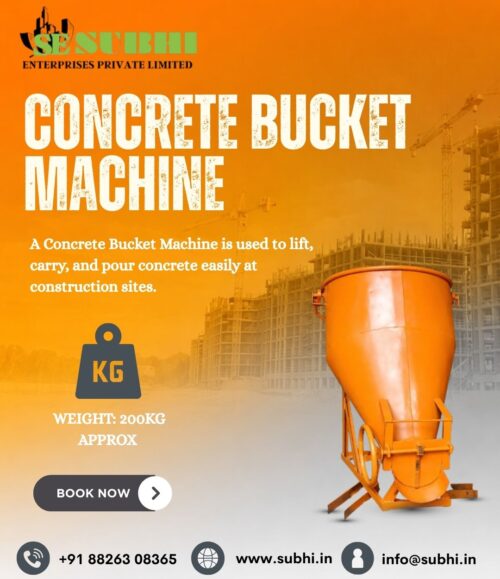
Concrete buckets are a specific form of construction equipment that are intended for the transportation and discharge of concrete using a controlled discharge system. They are typically fixed to the arms of construction cranes and are intended for the discharge of concrete into construction frameworks, often in difficult-to-access areas. Concrete buckets reduce the manual handling and transportation of concrete by providing an automated mechanism that aids in the spillage while allowing for an even distribution of concrete during a pour.
Concrete buckets are manufactured from heavy-duty, industrial-grade steel so that they can withstand the heavy weight and abrasion of the liquid concrete and the construction sites.
The Importance of Concrete Buckets in Construction
Concrete buckets play an important role in improving construction site workflows. The construction buckets are of great value to modern construction sites for the following reasons:
- Controlled and precise placement of concrete
- Limit the labor force required to complete a pour
- Decrease the amount of concrete expended during a pour
- Enhanced pour and site safety
- Add to the overall speed of construction
Concrete buckets are an absolute necessity for construction sites that require the vertical placement of liquid concrete to be performed, such as for the construction of structural walls, beams, slabs, and columns.
Bucket Types Used in Concrete Pouring
Concrete buckets can be designed to fit a specific construction requirement. The most common types are detailed below:
- Bottom discharge concrete buckets
Concrete is released from a bottom discharge concrete bucket through a gate at the bottom. This type works best with small wall and column pours. Concrete can be released using a lever system or through a manual discharge control.
- Side discharge concrete buckets
Concrete can be poured to the side using a side discharge concrete bucket. This is best for larger slab pours and other wide surface pours, as it allows for concrete to be spread easily over a large surface.
- Lay down concrete buckets
This type of bucket can be laid down or tilted on its side to allow for horizontal concrete pouring. This is normal for large foundations and bridges.
- Crane-Mounted Concrete Buckets
These buckets are intended to be used in conjunction with mobile or tower cranes. They are the most popular type of bucket used in high-rise construction.
Concrete buckets are engineered for specific project and site needs.
Understanding the Functionality of Concrete Buckets
The functionality of a concrete bucket is very simple. Concrete is poured into the bucket from a concrete mixer or batching plant. The bucket is then lifted by a crane to a location where the concrete is supposed to be poured. Once the location has been determined, the operator opens the discharge gate.
This mechanism allows the operator to control where the concrete is to be deposited, aiding in improving the overall quality control and structural integrity of the concrete.
The Factors of a Quality Concrete Bucket
In choosing a concrete bucket, one must choose the bucket that has the features that improve the overall performance and durability.
- Heavy-duty steel construction
- Evenly smoothed inner walls
- Reliable control over the discharge system
- Robust lifting hooks or lugs
- A coat that’s resistant to corrosion
- A bucket that is well designed to improve the overall site efficiency and will last a long time.
Benefits of a Concrete Bucket
Construction professionals have many advantages that come with the use of a concrete bucket.
- Improved site efficiency
A concrete bucket speeds up the concrete pouring process, allowing faster project completion.
- Increased Safety on site
A concrete bucket allows for little manual manipulation, which can lead to injury on site.
- Less Material Waste
Controlled pouring means less concrete spillage and waste
- Improved Quality Finish
Better surface finish and stronger structures are achieved by evenly placing the concrete.
Applications of Concrete Bucket
A concrete bucket is commonly utilized in many construction activities, such as:
- Construction of high-rise buildings
- Projects involving bridges and flyovers
- Concreting of columns and beams
- Construction of slabs and floors
- Precast concrete activities
A concrete bucket is a beneficial tool regardless of project size.
How to Select the Proper Concrete Bucket
Several factors determine the correct selection of a concrete bucket.
- Capacity
Select concrete bucket capacity in relation to the crane lifting capacity and the volumetric requirements of the project.
- Discharge Type
Depending on the nature of the work, you can choose a bottom discharge concrete bucket or a side discharge concrete bucket.
- Quality of Material
For strength and durability, a concrete bucket should be made of quality steel.
- Compatibility
A concrete bucket should be compatible with your crane or other lifting equipment.
Right selection yields increased efficiency and maximizes the value over time.
Concrete Bucket Maintenance Guidelines
Cleaning the concrete bucket after every workday is the best way to extend the lifespan of your concrete bucket and ensure it operates safely and functionally.
- Discharge Mechanisms should be inspected
Checking the discharge mechanisms should be done on a routine basis.
- Ensure the Lifting Points are not Worn
Worn lifting points should be checked to look for cracks.
- Apply Anti-Rust Coating When Needed
Concrete buckets that are maintained will perform better and even have a longer lifespan.
Using a Concrete Bucket Safety Guidelines
Using a concrete bucket is not a complex task, but the safety of the operation is of the utmost importance.
- Do not load the concrete bucket beyond the limit.
- Ensure proper crane operation.
- Workers should remain clear of and not be under the load.
- Use a hardhat, safety goggles, and the required PPE.
Costs of Concrete Buckets
Concrete buckets are not a cheap add-on, but when it comes to safety and the efficiency of your operation, they are economically defensible.
Innovations in Concrete Buckets in Construction
Focusing on automation and other solutions to increase efficiency in construction creates a need for new designs in concrete buckets. Recent models offer improved design and construction for better ergonomics, safety, and discharge control, which increases their utility on construction sites.
Conclusion
A concrete bucket is a tool that increases safety and efficiency in the construction process while decreasing the overall workflow in the placement of concrete. Precise placement of concrete is done in high-rise construction and all other types of infrastructure construction with a high-quality concrete bucket. Improving a construction operation can be achieved by using the right concrete bucket and maintaining it well.
Concrete buckets are a great investment for construction sites with the labor-saving and productivity-increasing benefits they provide.