
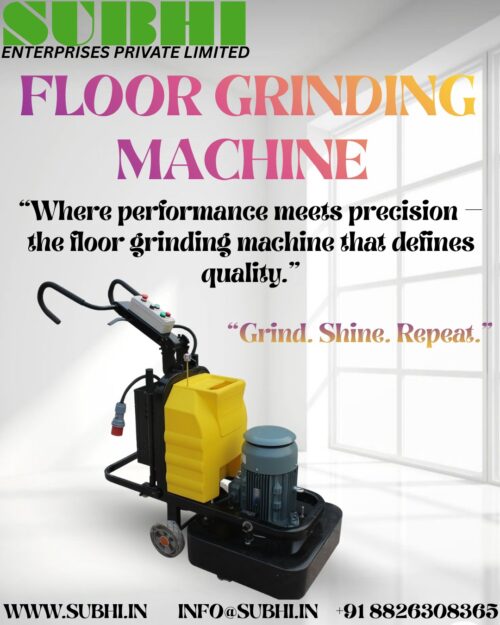
Achieving a smooth, quality finish to a surface is only possible using a floor grinding machine. This machine is appreciated by builders, contractors, and finishers and is also time and cost efficient for multiple kinds of flooring, such as concrete, marble, and granite. In addition to the previously stated reasons, the machine’s value also lies in its precision, speed, and dimensional accuracy. Various problem-solving techniques provided by the user for surface floor enhancements unlock the full potential of this machine.
Key functionalities of the machine consist of restoring a refinished floor to an even and flawless condition, smoothing and refining a worn surface and its irregularities, debulking patterned substrates, stripping adhesive or any minor imperfections that remain, and polishing any transitioned surface to a desired sheen.
This guide aims to consolidate and provide the most useful information and to explain the benefits, the purpose, and most importantly, how to evaluate the best alternatives for specific applications in floor grinding.
What is a Floor Grinding Machine?
A floor grinding machine is a type of construction machine used for final finishing of concrete, smoothing, and polishing. This machine employs diamond grinding, described as polishing with revolving disks, and it can also be used in renovation construction for polishing concrete. Depending on the machine’s construction, it can also handle stone floors, marble, terrazzo, and granite. These machines can be adapted for a variety of other surfaces as well.
Working Principle of a Floor Grinding Machine
A floor grinding machine works on the principle of abrasion, and the following tasks must be accomplished in order. Dust Control System: Innovative machines are capable of performing grinding activities while simultaneously vacuuming the dust and debris generated during the process. This service is utilized during the preparation of the surface for polishing and smoothing, coating, and final prep, and also acts as a smoothing prep. When selecting a machine for grinding, finishing requirements, project size, and type of materials to be processed are critical. The usual machines employed are as follows:
1. Single-Disc Floor Grinder.
A simple grinder that finds application in basic applications such as floor leveling and edge grinding. It is utilized for the domestic and light commercial market.
2. Planetary Floor Grinder.
This type of grinder is capable of handling larger industrial and commercial projects. The different pivoting capabilities of the multiple heads allow for more refined finishes, as they provide uniform grinding.
3. Dual-Disc Grinder.
It is meant to work on medium to large surfaces. It enhances the efficiency in surface preparation by removing adhesives, coatings, and other surface impurities. Its two counter-rotating discs improve the removal process efficiency.
4. Remote-Controlled Floor Grinding Machine.
The machine is meant to do large-scale commercial jobs while offering limited operator input. It is best suited for repetitive operations.
5. Edge Grinder.
This machine can work in spaces where big machines cannot access, i.e., vertical walls, corners, and other small spaces. For total surface coverage, it collaborates with bigger machines.
The Advantages of Floor Grinding Machines
In your maintenance plan, adding a floor grinding machine will preserve your floor with an added aesthetic appeal.
1. Consistency and Smoothness
A grinding machine will produce flawless surfaces and will serve great utility and aesthetic value.
2. Enhanced Floor Durability
Ground, bonded, and worn superficial, interlocked floor coating layer weaknesses and detachments will be removed. This will enhance and make the floor durable.
3. Reduced Cost of Maintenance
Due to the elimination of complete floor replacements, expensive maintenance costs will be reduced.
4. Dustless Operation
With advanced grinding machines, complete fine dust collection systems will temper the dust created during grinding operations.
5. Enhanced Safety
Achieving flat, smooth floor surfaces with lesser potential of a slip will translate to much safer working surroundings.
Uses of Floor Grinding Machines
The unmatched versatility of floor grinding machines can be seen in the following fields:
Construction: Pre-polishing or finishing concrete floor surface conditioning.
Warehouse Redevelopments: Smoothing and straightening concrete for flooring replacements.
Commercial applications include finishing surfaces of marble, granite, and other materials. We enhance these finishing touches even more for surface and edge finishing.
Restore & Recover took care of worn surface floors for our residential clients. We built surface removal for residential clients for Recover & Restore.
For our hospitals and airports, we select durable and low-maintenance floor finishes. These finishes are also dust-free.
In the case of different types of work and flooring, the style of floor grinding machine is determined from the list below:
1. Surface Material.
The choice of the grinding head to be used is determined by the surface material. For example:
Concrete: diamond-segmented tools.
Marble & Granite: resin-bonded polishing pads.
Epoxy & Coating: metal-bonded stripping pads.
2. Machine power and speed.
Grinding machine speed is power dependent for larger projects.
3. Dust collection system.
A floor grinder with a built-in dust extractor is suited for polishing.
4. Ease of use.
The design of the machine, which promotes reflex and ergonomic principles, reduces the fatigue of the operator.
5. Maintenance and spare part purchase.
Reliability for equipment is improved by maintenance spare part purchasing, which is designed for scheduled and streamlined maintenance.
Maintenance of Floor Grinding Machines
To ensure complete functionality, the following should be performed:
Routine cleaning: Each machine needs to be cleaned after use. Each machine creates some new debris, and neglecting cleaning simply creates more problems.
Change or Check the Grinding Disks: For the machine to operate to the highest standard, the grinding discs must be in excellent condition.
Preventive Lubrication: All the movable parts must be lubricated to avoid excessive damage and wear.
Review the Electrical Infrastructure: The wires, switches, and motor systems should all be intact and functional.
Appropriate Storage: The preferred method of storage is in a protected, dry, and clean environment. The more consistently the machine is cleaned, the more even results the machine will provide and the longerthe machine will last.
Safety Precautions in the Use of Floor
Grinding Machines
Due to the size and mass of the machines in use, it is crucial to provide more attention to the safety measures described below. The complete ensemble of protective gear includes gloves, goggles, and a dust mask. Checking machine and power source compatibility, removing all unnecessary distractions and unauthorized individuals from the setup, and never leaving a machine unattended while grinding must all be part of the safety measures.
The guidelines serve to help you complete a task in a timely manner while minimizing risk.
Advances in Floor Grinding Technologies
There have been changes in technologies made by grinding machine manufacturers. The most important changes are the following.
- Self-Operating Grinders. This was designed to reduce required labor and to increase precision.
- Grinding machines with variable speed control. This was created to better accommodate different conditions of various surfaces.
- Advanced Planetary Motion Grinding Systems. This is the state-of-the-art system for machines, which ensures even grinding. This is the most recent advancement in grinding machines.
- Worker Safety Improvements Alongside Environmental Conservation
Recent innovations in “floor grinding” machinery focus on ease of use, efficiency, and environmentally considerate use of substitutes.
Concluding Remarks
The role of “floor grinding” machines in the construction industry definitely deserves recognition. They make the work finer, smoother, and complete to give shine to the flooring and finishing on the surface, while making the surface even more beautiful. But aside from the gloss and beautification finish of the task, the machines also possess the refinining and withstanding finishing work. The varied functions and various kinds of machines, and even the varied and different parts and their appropriate maintenance satisfy the customers. For the well-constructed and well-maintained machines, a lot of prep work can be done at great standards; and at a high standard the prep work of a domestic and industrial flooring projects. The machines leave a smooth and lasting surface as their end product.
Final Thoughts
The final flooring surfaces hugely influence the durability and the aesthetic of the building. This is why the construction industry receives the valuation that it does.
A machine garners value from the value it brings to an industry, such as the addition of total finishing to surfaces, the reduction of the owner’s maintenance costs over years, and the enhancement of quality of the finishing.
The demand for these machines has risen because of the increased need to modernize older technologies for the first time. This makes these machines necessary for all contractors, builders, and flooring professionals in the maintenance of service excellence.