
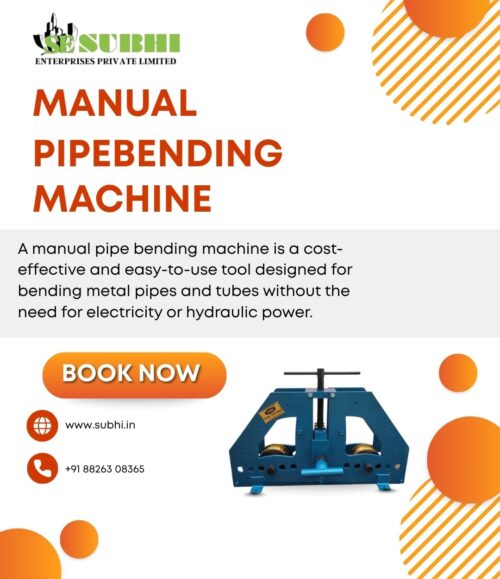
Manual Pipe-Bending Machines Today, the construction and fabrication industry emphasizes the importance of precision and cost control. Whether a small workshop owner, fabrication professional, or contractor working onsite, the right tools can make a significant difference. One of the essential tools is the Manual Pipe Bending Machine. Manual Pipe Bending Machines are simple, durable, and affordable. Regardless of the presence of competing hydraulic and electric options, Manual Pipe Bending Machines are still preferred industry-wide.
This comprehensive guide will allow you to explore the Operating Manual Pipe Bending Machine, and cover its applications, benefits, limitations, and how to select the best Manual Pipe Bending Machine for your business.
What is a Manual Pipe-Bending Machine?
A Manual Pipe Bending Machine is one of the many mechanical tools that bend metal pipes and tubes, using no electricity or hydraulic systems. Instead of using power, the system requires the use of human effort, usually via a lever or handle system, where the push that shapes the pipe to conform to the stationary die is achieved.
The majority of manual pipe-bending machines can handle MS pipes, GI pipes, aluminum pipes, copper tubes, and mild steel pipes. The machines are easy to operate and can create bends without affecting the strength of the pipes.
Because it does not depend on power, the Manual pipe-bending machine is ideal for those jobs that require power tools but where there is either no electricity or it is not steady; hence, a dependable solution on site.
Functionality of a Manual Pipe-Bending Machine
The functioning of the Manual pipe-bending machine is simple. A piece of pipe is put into a bending die of the same diameter. Then, the operator uses a long lever to apply a bending force to the pipe.
Important parts of a Manual pipe-bending machine are:
- Tough steel body
- Bending dies of various sizes
- Lever/handle
- Clamp/holding mechanism
- Degree scale for precision bending
Manual Pipe-Bending Machines As in the example above, controlled mechanical action ensures that the pipe bends without collapsing or cracking (using the correct die and technique), and working with different parts of the machine ensures that different aspects of the mechanical action slide against each other.
Variations of Manual Pipe-Bending Machines
Different bending requirements can be achieved by different variations of a Manual pipe-bending machine.
Some of the variations include the following:
- Hand Lever Type Manual Pipe-Bending Machine
This is the most common type, ideal for light to medium-duty work. Compact, portable, and affordable.
- Ratchet-Type Manual Pipe-Bending Machine
This version requires less effort and provides for better control during bending, especially for the thicker pipes.
- Heavy-Duty Manual Pipe-Bending Machine
The Manual Pipe-Bending Machine is made for industrial activities. It has a modified, stronger frame and also has a longer lever for greater force.
Each style of Manual Pipe-Bending Machine caters to particular requirements, making it easier to select.
Uses of the Manual Pipe-Bending Machine
The adjustable nature of the Manual Pipe-Bending Machine makes it fit for different sectors, such as:
- Construction
- Plumbing
- Furniture
- Handrails and railings
- Automotive
- Greenhouses
- Industrial Pipe Fitting
In every service, be it a small workshop or a large fabrication unit, the Manual Pipe-Bending Machine is significant for effective and accurate shaping of metal pipes.
Advantages of Manual Pipe-Bending Machines
- Cost-Effective Choice
Manual Pipe-Bending Machines cost less than hydraulic or electric models. This makes it ideal for small businesses and startups.
- No Power-Demanding
The Manual Pipe-Bending Machine is a cost saver as it does not demand power, working on combustion, which also makes it easily portable.
- Simplistic Operation
The Manual Pipe-Bending Machine is easier to use as it takes less time to train on the machine.
- Maintenance is Nil
The Manual Pipe-Bending Machine has fewer movable parts, which results in less to no maintenance because it will remain reliable for long-term use.
- Portability
Most models of manual pipe-bending machines are lightweight, portable, and easily transportable, making them ideal to use off-site.
Drawbacks of a Manual Pipe-Bending Machine
Although a Manual pipe-bending machine has many benefits, it also has a few drawbacks:
- Requires physical effort
- Inadequate for large-scale production
- Bending thickness is limited when compared to hydraulic machines
- The operation is slower
For low to medium workloads, these drawbacks are often outweighed by simplicity and lower cost.
Manual Pipe-Bending Machine vs Hydraulic Pipe-Bending Machine
| Feature | Manual Pipe-Bending Machine | Hydraulic Pipe-Bending Machine |
|---|---|---|
| Power Source | Human effort | Hydraulic system |
| Cost | Affordable | Costly |
| Maintenance | Almost none | Moderate to high |
| Portability | Easy to transport | Less portable |
| Production Speed | Conservative | Rapid |
From a production perspective, a Manual pipe-bending machine is a good choice for businesses with tight budgets.
How to Choose the Right Manual Pipe-Bending Machine
There are many variables to consider when deciding on a Manual pipe-bending machine.
- Pipe Size Range
Make sure the Manual pipe-bending machines accommodate the pipe sizes you use the most.
- Material Compatibility
Machines are designed to cut specific materials such as MS, GI, aluminum, or copper.
- Build Quality
Heavy-duty steel construction is the sign of a long life and outstanding-performance machine.
- Die Availability
Specify a Manual pipe-bending machine that features multiple, interchangeable dies for maximum operational range.
- Ease of Use
Good designs are characterized by adjustable handles and productivity-enhancing angle indicators.
While operating a manual pipe-bending machine
Safety
To safely work with the Manual Pipe-bending Machine, the following rules must be followed:
- Protective gloves shall be worn.
- Pipe should be fastened down before bending.
- Do not exceed the rated capacity.
- Use the appropriate die size
- force that is not needed.
Following these practices enhances safety and lengthens the service life of the machine.
Manual Pipe-bending Machine Maintenance
Keeping a Manual Pipe-bending Machine well serviced helps to avoid:
- Dirty bends
- Jammed and broken moving parts
- Worn dies
- The Machine being kept in a dry and secure location
Manual Pipe-Bending Machines Cleaner bends and a longer service life will be a result of these practices.
Why the Manual Pipe-bending Machine is Still Popular in 2025
The Manual Pipe-bending Machine remains popular in 2025 because of its affordable and simple nature. It is the best option when investment needs to be recovered. It is relied on the most in developing markets and remote job sites.
Future Scope of the Manual Pipe-Bending Machine
Manual Pipe-Bending Machines As small-scale fabrication continues to expand, the Manual pipe-bending machine, as well as its demand, will likely remain constant. Designs are being enhanced due to the implementation of better leverage systems, more robust construction, and improvements to angle indicator precision. All of these features are making new models of the Manual pipe-bending machine more convenient to operate.
Conclusion
A Manual pipe-bending machine is an indispensable piece of equipment in the fields of metal fabrication, plumbing, and construction. For workshops and contractors, the low price, simple operability, portable design, and low-maintenance features make it a valuable piece of equipment.
Manual Pipe-Bending Machines. It is unlikely that a Manual pipe-bending machine will ever outpace the high-speed hydraulic varieties in volume production. However, it certainly outclasses them in terms of flexibility and precision at an economical price. The selection of the proper model and good maintenance help ensure years of satisfactory service. Manual pipe-bending machines are some of the best options in the market currently for a solution in bending pipes.