
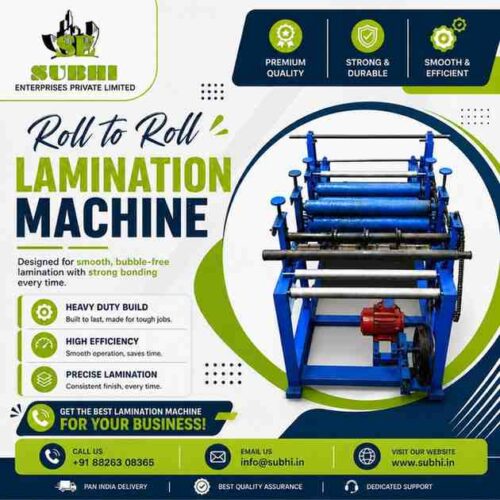
In todays’ competitive market, product quality is a key differentiator. The importance of product finishing is not just about the aesthetics, but about increasing the durability and resistance of a product to various factors such as moisture, dust, and abrasion. A Roll to Roll Lamination machine is an important equipment piece for improving the quality of a product through finishing.
Roll to Roll machines are designed to laminate flexible materials through a process of roll-to-roll formations. These Roll to Roll machines are designed to work with various flexible packaging materials, printed films, labels, papers, and even plastic films. Roll to Roll machines process flexible material in rolls, as opposed to the traditional method of processing individual sheets. In turn, this decreases production time and increases overall efficiency.
Roll to Roll machines offer excellent return on investment. If a company relies on continuous processing with consistent lamination, then a Roll to Roll Lamination machine greatly decreases time and effort required. These machines are especially helpful in the printing, flexible packaging, label, and industrial processing industries.
This guide comprehensive reviews Roll to Roll machines. Included are sections which review how Roll to Roll machines work, the various benefits, and the uses for the machines. Additionally, this guide offers sections on how to buy Roll to Roll lamination machines, the main features, maintenance, and answers to common questions.
What is a Roll to Roll Lamination Machine?
A Roll to Roll Lamination Machine allows the application of a protective or functional layer to a flexible material in roll form by bonding it. The base material is continuously moved between the unwinding and rewinding rolls after traversing the lamination section.
The combination of heat, pressure, and adhesive or any of these as the case may be, is used in the lamination process to bond layers of flexible materials.
For illustration, a printed material can be laminated with a protective layer to enhance the strength and appearance. Likewise, paper, plastics, labels, packaging films, and other specialty materials may be laminated using a Roll to Roll Lamination Machine.
The laminating system is roll-based and therefore is ideal for businesses requiring higher production volumes compared to the manual or sheet fed lamination processes.
How does a Roll to Roll Lamination Machine work?
The design of Roll to Roll Lamination Machines allows efficient and consistent material movement and bonding. Although there may be minor changes in the process according to the type of machine used, however, the entire process involves:
- Unrolling the Base Material
The base roll of the material is mounted on the unwinding unit. The machine manages the unwinding of the material under even tension.
- Unwinding
High tension and uneven tension during the process of unrolling results in wrinkles in the material.
- Feeding the Material
After unwinding, the material is fed into the feeding unit. In case of Roll to Roll Lamination, material is transferred using rollers and aligners.
In order to prevent defects in the product and obtain even edges, alignment of the two materials is required.
- Lamination
According to the specific design of the machine, different technologies are employed for bonding of different layers under pressure, temperature, and adhesive influence.
- Cooling or Curing
Cooling or curing sections may be included in some machines in the course of lamination. This procedure helps to ensure proper quality of the final bond.
- Rewinding
Following the lamination process, the material is collected on a rewind roll. A properly designed Roll to Roll Lamination Machine maintains constant tension during rewinding, and thus produces a final roll that is both neat and usable.
Key Benefits of Roll to Roll Lamination Machine
- High Production Efficiency
Single biggest advantage of the Roll to Roll Lamination Machine is the capability to perform a continuous process. Since the material are processed in a roll form, machine is capable to handle a high production load.
This advantage makes it appealing to the producers as an option to enhance production without increasing the burden of manual operations.
- Consistent Lamination Quality
Constant bonding is essentially the foundation of quality as it relates to industrial lamination. Roll to Roll Lamination Machines are more controlled as they cover the gap in speed, tension, and pressure.
With a consistent scope, businesses can improve the quality consistency of their products.
- Automation of a Time Consuming Process
Manual lamination can be a time consuming and inconsistent process. With the automation of the roll-to-roll process, the handling of materials become significantly less.
- Produce a Smoother Workflow
Along with having the ability to process a variety of materials, Check the versatility of the machine Flexible materials include paper and plastic films to labels and even packaging materials.
Better Defense Against Harmful Elements
Lamination adds an extra layer of protection to a final product. The barrier of lamination serves many purposes against a variety of elements including moisture protection, preventing handling damage, and limiting the surface of the material.
This is commonly used in printed product applications that involve packaging.
- Add Value to Materials
An aesthetically finished product is achieved through lamination. The appearance of the product is enhanced by the finish of the lamination film. Glossy, matte, or protective finishes are all achievable with lamination.
- Meet Business Needs
The Roll to Roll Lamination Machine has the ability to improve the appearance of a wide variety of products.
- Consistency and Quality at Scale
The Roll to Roll Lamination Machine allows businesses to achieve industrial quality and consistency during production at scale.
- Flexible Packaging Industry
In the flexible packaging industry, this machine enables the formation of multiple layers of films and materials to create strong, aesthetically pleasing, and high performing functional packaging.
- Printing Industry
Rolls for printing can be laminated to enhance the finish and provide surface protection. This technology is useful for many commercial and industrial printing applications.
- Label Manufacturing
Labels typically require a protective or functional layer. A Roll to Roll Lamination Machine also enables continuous process of label materials, thereby assuring uniform quality.
- Plastic Film Processing
Plastic films can laminated with several other layers to provide multi-layer structures. These laminated films can be used for various industrial and packaging purposes.
- Paper and Specialty Materials
Some paper products as well as specialty substrates can be processed by roll-to-roll lamination where the equipment is properly configured.
- Industrial Material Manufacturing
Many industrial products require multi-layer flexible materials. A Roll to Roll Lamination Machine is built for controlled continuous processing.
Important Features to Look for in a Roll to Roll Lamination Machine
Understanding the production requirements to evaluate the features of a machine is vital before a purchase is made.
- Adjustable Speed Control
The speed of processing different materials varies. The use of an adjustable speed control machine can help improve production while maintaining lamination.
- Stable Tension Control
The control of stable tension can greatly enhance the quality of the production. Tension should be maintained during the unwinding and rewinding.
- Precision Rollers
Materials require rollers that ensure smooth transport and even pressure when undergoing a lamination process.
- Accurate Temperature Control
Even heat distributions are critical for even material bonding of lamination processes using heat.
- Strong Machine Structure
Machinery used in a continuous lamination process must have solid structures to maintain strong operations.
- Easy Operation
Roll to Roll Lamination Machines become even easier to use and monitor if they are equipped with an advanced control system.
- Safety Features
Finally, systems that automate the removal of dangerous and/or hazardous components are essential.
- Reliable Rewinding System
The final quality of the produced roll depends on the rewinding system. The system must correctly produce a finished roll which is neat and has the right amount of tension.
How to Choose the Right Roll to Roll Lamination Machine
The right Roll to Roll Lamination Machine is an important investment decision. A company should evaluate the production requirements in order to purchase the right machinery efficiently and without wasting money on unnecessary equipment.
- Understand Your Material Type
Understanding the materials you wish to laminate is the first step. Knowledge of their thickness, flexibility, surface type, and bonding requirements can help materials to be laminated in an efficient way.
Not all Roll to Roll Lamination Machines work with the same materials.
- Check Required Production Capacity
If your company requires high volume production then you must purchase a machine that can facilitate that production. Buying a machine with insufficient production capacity will result in a production bottleneck.
- Consider Working Width
The working width should be the same as the width of the rolls of materials.
- Evaluate Lamination Technology
Different devices use different lamination methods. Make a selection depending on the material and the final product.
- See Automation Level
Different systems have different levels of automation and control. Select the level appropriate to your volume and needs.
- Think About Service and Support
Performance after the sale is important, as is the availability of spare parts. Working with a good supplier can help keep things running on your machines.
Why Regular Maintenance Is Important
All industrial equipment requires maintenance to perform optimally. This is also true for Roll to Roll Lamination Machines.
- Clean Rollers Regularly
The performance of rollers can be negatively affected by adhesive, dust and particles.
- Check The Tension System
Check if the system is functioning to keep the required constant and even under control during the lamination process.
- Check Temperature Control
For systems that involve heat, the temperature control system should be checked to maintain the required temperature.
- Moving Parts in Contact Need Lubrication
The manufacturer’s recommendations should be followed to keep everything in good working order.
- Check Electrical Components
Safety systems should be checked regularly.
- Operator Training Is Required
Even the best of machines is worthless if it is not operated correctly. This is especially true for high-end Roll to Roll Lamination equipment.
- Wrinkles in the Material
There are many reasons why wrinkles could be formed in the final product. It could be due to poor process control, wrong alignment or bad rollers. This is why regular maintenance is a must.
- Uneven Lamination
Bond strength can be impacted by non-uniform pressure or temperature. It is crucial that the settings of the equipment are adjusted based on the type of material used.
- Poor Adhesion
Adhesive application error, inappropriate temperature, inadequate pressure, inadequate adhesion, or miscompatible materials can yield poor adhesion.
- Material Misalignment
It is imperative that the systems used for material alignment be inspected on a constant basis. It is important to note that even a minor alignment problem can adversely affect the quality of a continuous roll.
- Excessive Material Waste
Material waste during the initial set-up can be minimized by reducing the quantity of material used for the test run to evaluate the optimal equipment settings.
Why Businesses Should Invest in a Roll to Roll Lamination Machine
Competitive manufacturers focus on increasing efficiency during the production process. In this regard, Roll to Roll Lamination Machines provide uninterrupted production and consistency while reducing the need for labor intensive activities.
The Machines also permit users to improve the quality of their products. Where the quality and durability of the product are critical for the finished good, professional lamination is a good option that provides incremental value to the product.
Increased demand for greater production volumes is easily accommodated by an adequate industrial lamination system.
The best results come from using compatible materials, consistent machine settings, and adequate maintenance.
Roll to Roll Lamination Machine from Subhi Enterprises
Subhi Enterprises provides customized solutions with equipment and machinery for your industrial and construction needs.
When deciding on a Roll to Roll Lamination Machine, you should address your specific needs with the supplier — materials, roll width, production volume, lamination method, and level of automation.
When choosing a Roll to Roll Lamination Machine, it is always recommended to choose the solution based on the application instead of selecting based on the price. A Roll to Roll Lamination Machine that is built to your requirements will support your production needs and positively impact your operations and product consistency.
For more details regarding our machinery, your product needs, and your business requirements, you can freely contact Subhi Enterprises:
📞: +91 88263 08365
🖭: info@subhi.in
Questions Asked Frequently about Roll to Roll Lamination Machinery
- What is Roll to Roll Lamination Machine?
The Roll to Roll Lamination Machine is one of the industrial machines that are used for laminating the materials which come in the form of a roll. The machine laminates the given material from an unwinding roll to a rewinding roll continuously.
- In which industries is a Roll to Roll Lamination Machine used?
Roll to Roll Lamination Machine can be applied in flexible packaging, printing, labels making, manufacturing of plastic films and paper, among others.
- What are the materials that get laminated?
Among others, paper, plastic film, printed material, labels, and many other flexible materials are laminated by a Roll to Roll Lamination Machine.
- Why roll-to-roll lamination increases productivity?
Continuous roll-based process of roll-to-roll lamination tremendously increases productivity and capacity of manufacturing. It is much more productive than laminating processes of any other kinds.
- How does temperature affect lamination?
For heating based systems, temperature must be controlled. If the temperature is not correct, the bonding will not be of good quality, or the sensitive materials may be damaged.
- What are the best practices to avoid wrinkling during lamination?
There are several factors that may help in reducing wrinkles during lamination e.g. proper control of tension, correct material alignment, clean rollers, and correct settings of the machine.
- What should I consider prior to purchasing a Roll to Roll Lamination Machine?
These are some of the things that matter most during the buying process: the type of material that the machine can accommodate, the width of rolls, production capacity, speed, the method of lamination, the level of automation, the safety features of the machine, how much the machine costs, how much the supplier will support you after you have purchased the machine, and how much you will need to maintain the machine after you purchase it.
- Is there need for maintenance of the machine?
Yes. Cleaning, checking of the rollers and tension mechanism, lubrication, and electrical tests are just but a few ways through which efficiency of the machine can be increased.
- Can one machine process different roll materials?
Some machines are able to work with different roll materials, but the actual capacity of the machine is dependent on the specifications and the configuration of the machine.
- Where can I direct my questions about the Roll to Roll Lamination Machine?
You may contact Subhi Enterprises for specific product questions and to clarify your application and the machine requirements.
Conclusion
A Roll to Roll Lamination Machine is a good investment for manufacturers that need automated and consistent flexible material lamination. The roll-to-roll process facilitates lamination of materials such as flexible packaging, labels, and films. This process can help manufactures reduce time taken for production and improve the quality of the finished product.
In case of the right selection of machinery along with proper operation practice, there is every possibility that the manufacturers will get proper performance and quality products from Roll to Roll Lamination Machines.
There is no better method of production in the current industry than the production lines. Nevertheless, there are some problems with them. One such problem could be improper operations resulting in poor performing machines. In this regard, the good lamination machines will make good investments if the manufacturer has chosen the right machinery.
If you want to compete in the market, you need to be producing things in an effective manner.