
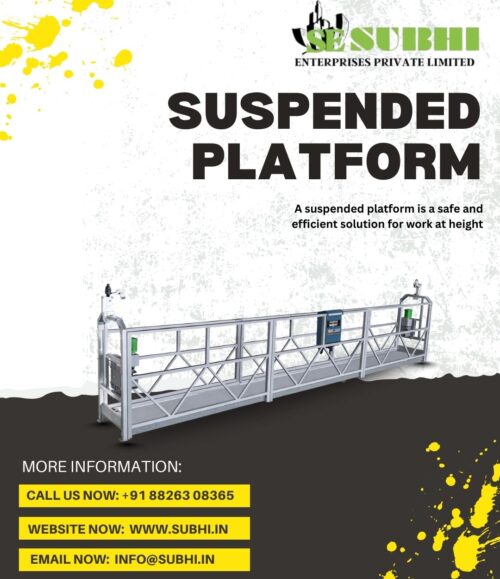
Working at height presents numerous challenges that are often very dangerous across all industry verticals, whether construction-related, maintenance, or working with facades. Whether it is high-rise buildings, bridges, industrial plants and silos, or other structures, it is always critical to find safe and efficient methods to access elevated work areas. This is where the suspended platform comes into play. Most access solutions in the market today are substandard in comparison to suspended platforms, which provide safe working surfaces that are stable and flexible at any height, eliminating the need for scaffolding in the majority of applications.
Over the years, suspended platforms have increasingly become invaluable to all types of contractors, builders, and maintenance personnel. Their ability to provide vertical transportation for multiple workers and to carry large tools makes them the ideal choice for work requiring precision, speed, and safety. This comprehensive guide details all aspects of the suspended platform, including what they are, how they work, components, types, applications, advantages, safety, and how to determine which suspended platform is best for your project.
What Is A Suspended Platform?
Platforms, either permanent or temporary, function as workspaces that are ‘suspended’ from the top of a structure via steel wire ropes or chains. Platforms can be taken up and down to the desired work height using either electric or manual lifts. Unlike scaffolds, which require extensive bottom support, suspended scaffolds require no bottom support. This makes them useful for very tall buildings, as well as for locations that are tight and limited in space.
Suspended platforms are used for construction, facade installation, painting the exterior, cleaning windows, plastering, maintenance work, and any repair work. Suspended scaffolds can be used to reach very difficult areas, and their design provides for the safety of the workers as well as their stability.
Key Components of Suspended Platforms
In order for suspended platforms to be properly cared for and maintained, their owners must be knowledgeable about their main components. A suspended scaffold/integral parts of a suspended scaffold/integral parts of a scaffold can be depicted as follows:
- Working Deck or Platform
A work deck or a platform is a place for workers to stand. Platforms are designed to be strong enough to withstand heavy loads and are typically constructed from steel or aluminum.
- Suspension Mechanism
The support structure above the work deck or platform is ‘suspended’ from the work deck or platform via steel wire ropes or chains. These cables/chains are the main load support for the suspended platform.
- Hoists
Electric or manual hoists control the vertical movements of the suspended platform. Electric hoists dominate the market, as they are easy to use and provide precise control.
- Safety Locks
Safety locks are very important in keeping the platform safe and avoiding any fall in case of failure by the wire rope or in case of overspeed.
- Guardrails and Toe Boards
These components include features that offer protection to workers and tools from slipping off the platform during operation.
- Control Panel
The operator can stop motion and raise or lower the suspended platform safely with the use of the control panel.
Types of Suspended Platforms
The following suspended platform systems are designed for different applications:
- Single Point Suspended Platform
This configuration depends on one lift point and is suitable for light-duty tasks such as window washing or other lighter maintenance jobs.
- Two-Point Suspended Platform
The most common of these is the two-point version. A two-point model provides steadier support compared to its one-point version and can handle more weight.
- Multi-Point Suspended Platform
Expanding the perspective to large-scale industrial projects, this platform comes with multiple suspension points for added strength and safety.
- Temporarily Shut Down Platform
These are used for short-term tasks, such as construction or repair activities.
- Permanently Installed Suspended Platform Systems
Permanently suspended platforms are incorporated into the architecture of buildings that require regular upkeep, maintenance, and cleaning of the exterior facades.
How Suspended Platform Systems Function
Suspended platforms operate on an uncomplicated yet efficient design. The platform is suspended from the top of the building on steel wire ropes, and there are hoists that control the movement in the vertical direction. The suspended platform can be positioned at any height to accommodate the workers. As an added layer of safety, there are safety locks and secondary ropes, which serve as backup to the primary systems.
The design allows suspended platforms to travel unobstructed along the vertical surface of the building, giving continuous accessibility without having to dismantle or reposition the equipment.
Uses of Suspended Platform Systems
Because of their flexibility, suspended platform systems can be used in many different fields, which include:
- Construction of high-rise buildings
- Exterior plastering and painting
- Installation and cleaning of glass facades
- Maintenance and repair of building façades
- Inspection and maintenance of bridges
- Maintenance of industrial plants
- Repair and building of ships
In all of these uses, suspended platforms provide substantial efficiencies while lowering the risks and costs associated with labor.
The Benefits of Using a Suspended Platform
The popularity of suspended platforms is based on several benefits:
- Greater Safety
Current suspended platforms have additional safety measures, such as safety locks, guardrails, and emergency stop buttons.
- More Affordable
Suspended platforms customarily have a lower cost than traditional scaffolding and decrease material, labor, and installation costs.
- Faster Completion of Projects
Suspended platforms have vertical movement and can be quickly set up, making them optimal for finishing projects.
- More Options
Suspended platforms can be adjusted, allowing them to fit a broader range of project needs.
- More Efficient Workflow
Workers can concentrate better on their work as scaffolding is not being moved, allowing them to work more efficiently.
Using a Suspended Platform
Working at height always has safety as the biggest concern. The following are the best practices when working with suspended platforms:
- Check all safety elements of the suspended platform before each use
- Make sure all workers are harnessed in before commencing work
- Always stay at or below the platform’s rated load
- Use the safety wires along with the wire ropes
- Hazardous weather should not be a working condition when a suspended platform is in use
- To each of the operators of a suspended platform, proper training needs to be given
Choosing to follow these rules decreases the risk of accidents.
Maintenance and Inspections
Routine maintenance provides your suspended platform with the ability to perform optimally over the long haul. Important maintenance practices entail:
- Examining wire rope for corrosion and general deterioration
- Examining and testing safety locks and hoists
- Assessing electrical components
- Cleaning and lubrication of all the moving components
In addition to keeping maintenance and safety standards high, a properly cared for suspended platform will last longer.
Determining Your Suspended Platform Needs
There are a number of considerations when it comes to selecting a suspended platform.
- Height of work to be accomplished and overall structure of the building
- The requirements of load capacity
- What type of work will be accomplished
- What is the anticipated frequency of use
- Are the anticipated safety standards being met
Working with a reputable supplier will make certain you are selecting a suspended platform to meet the requirements of your project.
What is the Difference Between a Suspended Platform and Scaffolding?
There are a number of differences between a suspended platform and traditional scaffolding. Most notably, a suspended platform reduces the amount of space required for a project, is faster to set up, and makes it easier to reach considerable heights. Scaffolding is certainly viable for low-rise projects, but it is not uncommon for suspended platforms to be the go-to for modern maintenance and construction on high-rise buildings.
Suspended Platform Systems in the Future
The suspended platform systems continue to adapt to the technological innovations of the construction industry. Modern systems incorporate automation, more advanced detection systems, and energy-efficient hoists. These advancements continue to improve reliability and ease of use, ensuring systems remain a viable solution to working at height.
Conclusion
Another feature that the suspended platforms are noted for is the innovative way of accessing heights, thus being a novelty in the market. The suspended platforms are also considered a must-have in the field of construction and maintenance, given the safety, cost-effectiveness, and productivity gain that they provide, among other benefits and qualities that the suspended platforms have been known to exhibit. Investing in a quality suspended platform guarantees safe access and operational efficiency, regardless of the project being a high-rise structure, an industrial plant, or an infrastructure project.
Choosing and operating a suspended platform can be done with confidence, given an understanding of its components, use specifications, applicable standards, and safety concerns. This is a platform that is designed and built to offer optimum sustainable solutions to the contemporary industry.