
Businesses focused on providing smart solutions to their clients are in a race to adopt the most hygienic and convenient food packaging solutions. For this reason, demand for disposable food packaging is increasing. Consequently, the opportunity for organizations producing disposable products is also increasing. As plastic and foam products lose their market, businesses are opting for eco-friendly alternatives such as paper plates.
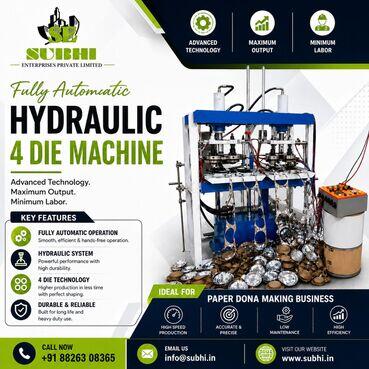
A fully automated hydraulic four die machine offers ease, consistency, and speed in production of paper plates due to its design having four die slots and a hydraulic system. This machine can be used to produce a variety of paper plate forms and sizes. This machine is extremely useful to clients who require large production capacity and are looking to maintain consistency in their product output.
Having a reliable fully automated hydraulic four die machine can ease a manufacturer’s work and reduce labor requirements. If manufacturers are looking to start or expand their paper plate production units, then this machine can help them automate their paper plate production.
This paper explains the functioning of a fully automated hydraulic four die machine along with its features and benefits, areas of application, and the factors a client should consider before purchasing this machine.
What is a Fully Automatic Hydraulic 4 Die Machine?
Four die machine hydraulic fully automatic is a machine used in industry to manufacture paper plates that have four dies. In this machine, the paper plates are formed through the use of hydraulic processes
Machines that are automatic require less operator attention compared to those that are manual. After setting the right conditions, the machine can repeat the process of forming the paper plates.
The flexibility offered by the four-die configuration lets manufacturers use the machine to process different plate sizes and designs based on the die configuration. This configuration may be an advantage for manufacturers who supply plates to different customers with different requirements.
Uniformity in plate-forming and finishing is achieved by the hydraulic mechanism with its controlled pressure.
How Does a Fully Automatic Hydraulic 4 Die Machine Work?
Processes that are involved in a Sequential Order in a Fully Automatic Hydraulic 4 Die Machine.
- Paper Material
The necessary paper or laminate paper is prepared in the form of plates according to the required size of the machine and die.
- Feeding of Paper
The paper is fed into the machine. Depending upon the nature of the machine, the feeding of the paper could be manual, semi-automatic, or automatic.
- Selection of Die
Based on required plate size and design, the die is selected. A four-die machine can produce different products when different dies are installed.
- Hydraulic Pressing
This system will supply the necessary pressure for pressing the paper material within the die. The result will be the required shape of the plate.
- Forming and Cutting
While the paper is being pressed, it takes the shape of the die. The forming process determines the edges, the depth of the plate and the overall shape.
- Plate Removal
After the formation is completed, the plate is removed from the die space. In case of automated equipment, it can be performed within the cycle of work of the machine.
- Quality Control
Completed plates may be checked for proper shaping, finishing of the edges, size and overall appearance before packaging.
Key Features of a Fully Automatic Hydraulic 4 Die Machine
A Fully Automatic Hydraulic 4 Die Machine, with modern design features, can handle a spectrum of tasks for commercial production.
- Four-Dye Configuration
A four-die configuration offers the manufacturing flexibility for meeting numerous product demands, based on die availability.
- Hydraulic Operating System
Hydraulic press creates centralized and consistent force required for forming.
- Automatic Operation
Automation removes the repetitive boring operations and has a positive impact on the organization of the production.
- Multiple Plate Sizes
With the addition of new dies, the machine can be reconfigured for different sizing and design opportunities.
- Consistent Production
Automated hydraulic pressing provides results that are more consistent compared to totally manual systems, as long as the machine has been properly set and maintained.
- Easy Operation
Control systems simplify the management of machine functions for operators. Operators should always refer to the operation manuals provided by the machine manufacturer.
- Strong Machine Construction
Industrial paper plate machines are designed for continuous production in high demand environments. A strong frame, in combination with a well maintained hydraulic system, helps improve a machine’s long term performance.
Advantages of a Fully Automatic Hydraulic 4 Die Machine
Adding a Fully Automatic Hydraulic 4 Die Machine to a paper plate production line can have considerable positive effects on production.
- Increase in Production Volume
Automation allows paper plate producers to fulfill large orders in a timely manner.
- Less Manual Labor Required
Automation means less repetitive tasks, which means that the producers can control the labor more efficiently.
- More Consistent Production
Since all production is done hydraulically, the plates will be more consistently shaped due to the constant speed of the die.
- Easier Production of Multiple Plate Designs
The machine is highly flexible to changing design needs as multiple die sets can be installed.
- Better Management of Production Processes
Automation makes it easy to regularly produce paper plates with consistent quality.
- Ideal for Businesses
This machine will be beneficial to businesses that supply paper plates to customers within the service and packaging industry, including restaurants, caterers, food vendors, wholesalers and distributors.
Applications of a Fully Automatic Hydraulic 4 Die Machine
A Fully Automatic Hydraulic 4 Die Machine can be used in various segments of the manufacturing process for disposable food-service products.
- Restaurants
Disposable plates are used by most restaurants for takeout orders, outdoor events, or special functions.
- Catering Businesses
Caterers may need a large number of disposable plates for weddings, parties, corporate functions, and similar events.
- Street Food Businesses
Disposable paper plates can be used by food vendors for selling snacks and meals, or other food products.
- Event Management
Large scale events may create huge demand for serving products like plates. Manufacturing units can customize plates of various sizes as per customer needs.
- Wholesale Suppliers
Paper plates in bulk can be purchased by wholesale traders from manufacturing units and can be distributed to retailers, food service vendors, and restaurants.
- Retail Businesses
Disposable plates in different packs can be sold by retailers for serving purposes in houses or for parties, gatherings, or for other smaller purposes.
Why Consider Four Dies?
One of the biggest advantages of using a four-die system is flexibility. A business may need to have several variations of products rather than just a single product.
One may need to have varying sizes of snack plates, serving plates, or larger plates for meal service. Different dies can allow manufacturers to make a range of products on a single machining unit.
Fully Automatic Hydraulic 4 Die Machines have excellent flexibility and can be very useful units for a business looking to make changes to their product line.
It is important for potential buyers to know the supported dies, production capacity, the range of materials that can be used, and the specifications from the manufacturer, prior to the purchase of the machining unit.
Things to Think About When Purchasing a Fully Automatic Hydraulic 4 Die Machine
Making decisions about purchasing equipment based solely on monetary value tends to yield suboptimal results in most cases. Many technical and commercial variables need to be analyzed.
- Production Requirements
Analyze your projected demand and company need. You should purchase a machine that is sufficient to take care of your company’s current and projected business.
- Die Sizes
What plates of what shapes can the machine process? If you plan to make many different products, ask about the available die options.
- Hydraulic Syste
This system is integral to the machine. Look into the hydraulic components, and see how much pressure the control system can maintain, and how easy it is to service and where you get replacement parts.
- Power Consumption
Know the power consumption of the machine before you even think about purchasing it, and see if the current available production space can accommodate the new machine.
- Dimensions
See how big the operating area of the machine is, and also account for the space machines take up, as well as material handling, operator travel space, and product storage.
- Maintenance
Ease of access to spare parts and technical services is vital.
- Safety
Operational safety features should be a priority.
Advice for maintaining Fully Automatic Hydraulic 4 Die Machine for high performance
Regular maintenance is the best way to maintain the performance of a Fully Automatic Hydraulic 4 Die Machine.
- Check Hydraulic Oil
Check the level of hydraulic oil and quality of oil as recommended. Ensure that the right hydraulic oil grade is used.
- Check Hydraulic Lines
Check hoses, fittings, and connections for leakage, damage or any wear. Immediate attention should be given to any hydraulic leakages.
- Keep Dies Clean
Paper dust and other residues can affect the quality of the forming process. Ensure that the dies are cleaned as follows;
- Lubricate Moving Parts
As recommended by the manufacturer, ensure that moving parts are lubricated accordingly. Lubrication can reduce friction.
- Check Electrical Parts
Control panels, switches, wiring and sensors should always be checked. Any electrical problems should be handled by a technician.
Keep the vicinity/working area clean
It is advisable to keep the work area around the machine clean of waste paper and other materials.
- Preventive Maintenance
Perform preventive maintenance regularly to avoid machine failure and resulting production delays.
- Safety Measures
- Observing the safety measures will help you to operate a Fully Automatic Hydraulic 4 Die Machine efficiently.
- Before using the machine, the operator should be adequately trained in emergency operating procedures, die changes, die handling procedures and operating cycles and control panel.
- No entry into the die and press areas while the machine is running. Before carrying out maintenance or die change, switch off the machine and follow recommended die changing procedure.
- Wear proper personal protective equipment as required, and keep loose articles away from moving parts.
Fully Automatic Hydraulic 4 Die Machine for Business
Launching a paper plate manufacturing business isn’t just about acquiring a machine. one should consider raw materials, labor, electricity, packaging, transportation, storage, advertising, and customer acquisition.
A Fully Automatic Hydraulic 4 Die Machine can be a good purchase for a paper plate manufacturing business as it can serve as the core production equipment. Before investing in this machine, estimate your future production demands and compare it against your financial resources and the expectations of your target market.
Before starting production, it is also necessary to identify potential customers. Paper plates can be sold to restaurants, food retailers, food wholesalers, caterers, distributors, and event organizers depending on the market.
Production of multiple sizes of paper plates can also help a business cater to different customer segments.
How to Improve Paper Plate Production Efficiency
Efficiency is not a characteristic of a single machine. The production process should be improved along with the machines.
Implementing continuous supply of raw materials is the first step of production improvement. Shortage of raw material can cause halt in production and increase downtime.
Proper training of production operators is necessary to determine abnormalities in a functioning machine and rectify problems related to machine hydraulics, dies, and defects in production.
Preventive maintenance of a machine also reduces production downtime.
Packaging and storage of finished goods should also be implemented in a production area to ensure efficient movement of materials from storage to production to packaging.
Reviewing production data is the last step in the production improvement process. Data on production output, materials consumed, downtime, rejected goods, and records on maintenance should be reviewed regularly for improvement.
Who should invest in a fully automatic hydraulic 4 die machine?
The Fully Automatic Hydraulic 4 Die Machine will definitely lure investors into entering the market and starting disposable paper plates manufacturing businesses or expanding existing ones.
It will be most appropriate for:
- New manufacturers of paper plates
- Manufacturers of disposable products
- Wholesale dealers
- Packaging
- Catering equipment manufacturers
- Business that requires increased output
- Manufacturers of different sizes of paper plates
It will all depend on the output requirements, budget allocation, types of products to be made and the intended customers.
Frequently Asked Questions
- What is a Fully Automatic Hydraulic 4 Die Machine?
A Fully Automatic Hydraulic 4 Die Machine is a machine for making paper plates in which hydraulic pressure and four die configurations are used for automation in paper plate manufacturing.
- What are the benefits of using four dies machine?
The four dies machine makes it possible to make paper plates of various sizes and styles.
- Is the machine good for use in commercial production?
Yes. The machine is good for commercial production of paper plates depending on the specifications and production capacity of the machine.
- Do different sizes of plates exist?
Yes. Different sizes of plates can be produced using different dies.
- Does the machine require an operator?
Although the machine is fully automated, an operator is required to control the settings, oversee the production process, and perform checks on the output of the production as well as perform routine checks.
- What maintenance does the machine require?
Regular hydraulic oil checks, hydraulic-line check, die cleaning, lubrication, and electrical check as well as preventive maintenance, are important. Always follow the manufacturer’s instructions on maintenance.
- Is hydraulic technology better for paper plate manufacturing?
Since hydraulic pressing systems have controlled forming force, the machine can be set to produce paper plates in a consistent manner.
- What should I check prior to purchasing the machine?
Check productivity, die sizes, power consumptions, machine dimensions, hydraulic systems, construction, warranty, spares, installation and post-sale service.
- Can a novice operate the machine?
With the right training, operating a machine is not difficult for a novice. Anyone operating the machine should know the controls, safety procedures, maintenance, and operation.
- How do I identify the right machine for my business?
Identifying the right machine for your business requires understanding your daily estimates for production, the sizes of the products, the available raw materials, the available space, the available budget, and future plans. After this analysis, technical specifications and service support must align in your comparison of different machines.
Conclusion
An addition of many efficient and flexible features makes the Fully Automatic Hydraulic 4 Die Machine suitable for the manufacturing of paper plates. Its hydraulic press mechanism combined with automatic operation and 4 die configuration all add to the ease and versatility of use.
The success of a paper plate manufacturing business stems from several factors including the selection of the machine but many other factors of equal importance are selection of raw materials, the investment in operator training, consistency in the quality of the product and the packaging, and the satisfaction of the customer.
Consider production capacity, supported die sizes, power requirements, design, warranty, spare part support, and service support, prior to buying a Fully Automatic Hydraulic 4 Die Press. Matching your factual business requirements to the equipment you purchase will allow you to arrive at a production solution that is not only reliable but also flexible and scalable.
The combination of purpose-built equipment and a proper production plan will help manufactures respond to the market requirement and build a sustainable business in the paper-service packaging market.