
streamlined workflows govern overall productivity, one machine has emerged as a lifeline for warehouses, manufacturing sites, logistics centers, and construction-supplying jobs: the stacker machine. Whether dealing with heavy materials and pallets or even cartons, steel products, and bulk goods, the efficiency provided by the stacker machine is beyond what manual labor can provide.
From improving safety standards to reducing operational fatigue and significantly boosting output, the STACKER MACHINE has transformed how industries handle and organize materials. Because of this, demand for advanced, energy-efficient, and easy-to-operate stackers has increased across India and worldwide.
From different types and how they work to its key benefits, uses, how it stacks up against forklifts, maintenance tips, and expert advice to pick the right model, this in-depth 2025 guide covers everything about the Stacker Machine you could ever imagine for your business needs.
WHAT IS A STACKER MACHINE?
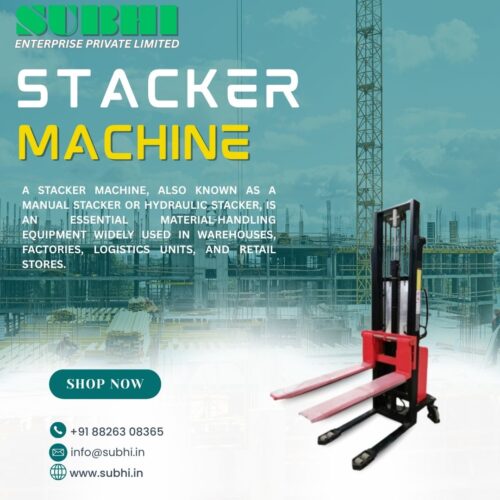
A stacker is a sort of material-handling machinery that is basically fitted with a capacity for lifting, shifting, moving, and stacking goods at different heights. It reduces manual strains in handling heavy loads, thus increasing the rate of operation and improving safety. You will most probably see a STACKER MACHINE where a forklift is too bulky, too expensive, or just not required.
Be it in the warehouses, retail outlets, construction material shops, production lines, or even distribution hubs, a stacker machine ensures higher efficiency, maintaining products vertically to save much floor space. Some modern models of stacker machines come with hydraulic lifting, ergonomic handles, a sturdy frame, and durable wheels to keep the movement smooth and stable, even on uneven floors. Electric stackers further amplify productivity with effortless lifting powered by a battery.
Why the Stacker Machine Is Becoming Essential in 2025
Industries today are shifting toward automation and cost-effective handling solutions. The Machine hits that sweet spot: affordable, mobile, and capable. Unlike forklifts-which require trained operators, space to operate in, and a hefty upfront investment machine is small, inexpensive, and easy enough for anyone with a bit of instruction to use.
Types of STACKER MACHINE (with a short description of each)
There are several models in the family of machines, each built for different workloads, lift heights, and settings. The following are some of the top contenders in use today:
1. Hydraulic Stacker Machine (Manual)
Most affordable and common. Powered by manual pumping through the hydraulic system. Great for small shops, warehouses, and retail storage.
Key traits:
- No electricity needed
- Low maintenance
- Robust hydraulic pump
- Able to lift moderately
Best for: Small warehouses, workshops, packing rooms, and manufacturing floors.
- Semi-Electric Stacker Machine
A compromise model that lifts electrically but moves manually. This combination of features reduces effort and accelerates vertical lifts.
Key characteristics:
- Electric lift
- Manual push/pull
- Ideal for medium-weight pallets
- User-friendly
Best for: warehouses having moderate activity and tighter budgets.
3. Full Electric Stacker Machine
The high-end version with both drive and lift electrically powered. Provides maximum productivity for continuous or heavy-use applications.
Key characteristics:
- Full electric drive
- High load-carrying capacity
- Smooth acceleration, easy to maneuver
- Ideal for large warehouses
Best for logistics firms, big distribution centers, and high-volume manufacturing.
4. Straddle Stacker Machine
For pallets without open bottoms, with adjustable legs straddling the pallet.
Key characteristics:
- Adjustable straddle legs
- Works with closed pallets
- Very stable
Best for: industries that deal with a variety of pallets.
5. Counterbalanced Stacker Machine
Removing the need for front legs, a rear counterweight allows the machine to get closer to shelves, racks, and tight spots.
Key characteristics:
- No front legs
- Broader reach
- Good for narrow aisles
Best for: retail, narrow warehouses, compact storage spaces.
6. Reach Stacker Machine
Premium option with an extendable mast reaching deep into racks. Common in large warehouses and storage hubs.
Key characteristics:
- Long
- extendable mast
- Reach deep down – High stacking heights.
Best for: high-rise warehouses and distribution centers.
How a Machine Works-Step by Step
The concept is simple, yet efficient: hydraulic or electrical systems drive vertical movement, and the rest is taken care of by the rest. Here is a typical operation sequence:
1) Load Placement: Goods or pallets go on either the forks or the platform.
2) Lifting Mechanism: Manual stackers, Hydraulic pump powered by a hand lever.
3) Electric stackers: motor-driven lifting system.
Movement:
The operator pushes, pulls, or drives the machine (depending on model) toward the desired location.
Stacking:
The mast lifts the goods to the required height, allowing precise stacking on racks or shelves.
Lowering:
Goods are lowered down safely either with hydraulic controls or buttons for electric lowering.
It simplifies the workflow while minimizing the physical burden on workers.
Major Benefits of Using a STACKER MACHINE
Companies go for the machine due to the numerous advantages derived from:
- Higher Operational Efficiency
The machine quickens everyday handling tasks and enables the worker to move and stack materials at a faster rate than by manual means.
- Less Labor Fatigue and Fewer Injuries
Manual lifting may cause back strains and fatigue. A stacker machine reduces manual effort and enhances workplace safety.
- Space Optimization
Vertical stacking frees the floor space, enabling more goods to be stored in the same area.
- Long-term cost savings
As compared to forklifts, a machine has lower costs in procurement, maintenance, and operation.
- Range of Applications
The machine can handle pallets, boxes, drums, sheet bundles, construction materials, and much more.
- Ease of Use
With simple controls and ergonomic design, every worker can operate a machine without requiring minimal training.
Common Uses & Applications of the STACKER MACHINE
The machine can be used in many different industries. Key applications include:
- Warehouses and godowns
- Manufacturing facilities
- Material outlets for construction
- Steel and fabrication industries
- FMCG and food processing
- Pharmaceuticals
- Retail outlets
- Logistical and distribution centers
- Automotive manufacturing
- E-commerce Fulfillment Centers
With the ease of moving heavy loads, the machine can be considered a universal solution for material handling.
STACKER MACHINE vs Forklift – Which is Better?
The machine replaces a forklift, some may ask. It depends on your workload, budget, and space availability.
Parameter | Stacker Machine | Forklift |
Cost | Low | High |
Space Requirement | Very small | Large |
Maintenance | Low | High |
Training Needed | Minimal | Professional |
Best Use | Warehouses, small & medium units | Heavy industry, ports |
Safety | High | Moderate |
For warehouses, retail stores, and manufacturing units, the machine is the smarter choice. Forklifts are necessary only for extremely heavy-duty operations.
Maintenance Tips to Extend the Life of Your STACKER MACHINE
Healthy maintenance keeps your machine purring for years.
- Check Hydraulic Oil Levels: Running on low oil is harmful to lift performance.
- Wheels: Inspect for wear, replacing any damaged wheels to avoid accidents.
- Lubricate Moving Parts: Correct lubrication keeps it all running smoothly.
- Maintain Battery (Electric Models): Charge correctly and avoid overcharging.
- Inspect Forks and Frame: for bends and/or cracks
- Keep It Clean: Dust and dirt slow things down.
A well-maintained machine serves longer and efficiently at an optimum.
Buying Guide Expert: How to Choose the Best STACKER MACHINE in 2025
Consider these factors before purchase:
- Lifting Capacity: Reflect your normal lifting requirements—500 kg, 1 ton, 1.5 ton, or 2 ton.
- Height of Lift: Available options include 1.6 m, 2 m, 3 m, and 4.5 m.
- Operation Type: Manual, semi-electric, or fully electric, based on workload.
- Work Environment: For narrow aisles, compact or counterbalanced models are suitable choices.
- Build Quality: Prefer heavy-duty steel construction with high-quality hydraulics.
- Battery Efficiency: Electric models should have long-life and fast-charging batteries.
- After-Sales Service: Buy from trusted manufacturers who will provide service, support, and spare parts.
A well-chosen stacker machine considerably improves the work process, saves labor costs, and increases productivity as a whole.
Conclusion
The machine has become one of the most important tools for modern industries. Whether you operate a warehouse, manufacturing unit, or construction supply business, investing in a reliable machine can completely transform your material-handling operations. With advanced technology, durability, and ease of use, the machine stands out as a highly efficient, cost-effective, and future-ready solution for 2025 and beyond.